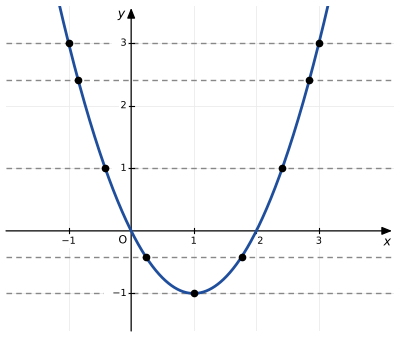
Solution:Since [tex]f(x)=(x-1)^2-1[/tex], the equation [tex]f(x)=t[/tex] has two solutions [tex]x=1\pm\sqrt{t+1}[/tex] if [tex]t\gt -1[/tex], one solution [tex]x=1[/tex] if [tex]t=-1[/tex] (the vertex) and none if [tex]t\lt -1[/tex]; different values of [tex]t[/tex] give different solutions. We work backwards.
Let [tex]y_3=f(f(f(c)))[/tex]. Then [tex]f(y_3)=3\Leftrightarrow (y_3-1)^2=4[/tex], so [tex]y_3\in\left\{3, -1\right\}[/tex].
Let [tex]y_2=f(f(c))[/tex]. From [tex]f(y_2)=3[/tex] we get [tex]y_2\in\left\{3, -1\right\}[/tex], and from [tex]f(y_2)=-1[/tex] we get [tex]y_2=1[/tex], so [tex]y_2\in\left\{3, -1, 1\right\}[/tex].
Let [tex]y_1=f(c)[/tex]. From [tex]f(y_1)=3[/tex] we get [tex]y_1\in\left\{3, -1\right\}[/tex], from [tex]f(y_1)=-1[/tex] we get [tex]y_1=1[/tex], and [tex]f(y_1)=1[/tex] gives [tex](y_1-1)^2=2[/tex], i.e. [tex]y_1=1\pm\sqrt{2}[/tex]. So [tex]y_1[/tex] takes five distinct values:
[tex]y_1\in\left\{3, -1, 1, 1+\sqrt{2}, 1-\sqrt{2}\right\}[/tex]
Finally, we solve [tex]f(c)=y_1[/tex]: for [tex]y_1=-1[/tex] there is one solution [tex]c=1[/tex], and each of the other four values is greater than [tex]-1[/tex] (note that [tex]1-\sqrt{2}\approx -0.41\gt -1[/tex]), so each gives two solutions. Hence the number of distinct numbers [tex]c[/tex] is
[tex]1+4\times 2=9[/tex]

 MENU
 Easy
 Function Graph Plotter
