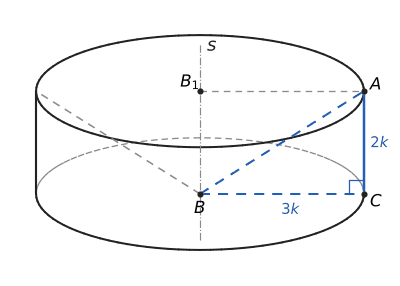
Solution:Let the right angle be at [tex]C[/tex], the shorter leg [tex]CA=2k[/tex], the longer leg [tex]CB=3k[/tex], and let the axis [tex]s[/tex] pass through [tex]B[/tex] parallel to [tex]CA[/tex]. Then [tex]CB\perp s[/tex], so [tex]C[/tex] and [tex]A[/tex] are at distance [tex]3k[/tex] from [tex]s[/tex]. Let [tex]B_1[/tex] be the projection of [tex]A[/tex] on [tex]s[/tex]; then [tex]BB_1=2k[/tex] and [tex]B_1A=3k[/tex].
In the rotation the leg [tex]CB[/tex] sweeps a disc with center [tex]B[/tex] and radius [tex]3k[/tex], the leg [tex]CA[/tex] sweeps the lateral surface of a cylinder with radius [tex]3k[/tex] and height [tex]2k[/tex], and the hypotenuse [tex]AB[/tex] sweeps the lateral surface of a cone with apex [tex]B[/tex], base radius [tex]B_1A=3k[/tex] and generatrix [tex]AB=\sqrt{4k^2+9k^2}=k\sqrt{13}[/tex]. So the solid is this cylinder with the cone removed:
[tex]V=\pi(3k)^2\times 2k-\frac{1}{3}\pi(3k)^2\times 2k=18\pi k^3-6\pi k^3=12\pi k^3=12\pi\Rightarrow k=1[/tex]
Hence [tex]CA=2[/tex], [tex]CB=3[/tex], [tex]AB=\sqrt{13}[/tex]. The surface consists of the disc, the lateral surface of the cylinder and the lateral surface of the removed cone (the other base of the cylinder is the base of the removed cone, so it is not part of the surface):
[tex]S=\pi\times 3^2+2\pi\times 3\times 2+\pi\times 3\times \sqrt{13}=9\pi+12\pi+3\sqrt{13}\pi=(21+3\sqrt{13})\pi[/tex]

 MENU
 Normal
 Volume and Surface Area Calculator
