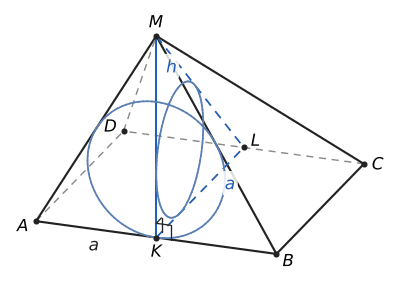
Solution:Let [tex]K[/tex] and [tex]L[/tex] be the midpoints of [tex]AB[/tex] and [tex]CD[/tex]. In the isosceles triangle [tex]ABM[/tex] the median [tex]MK[/tex] is also an altitude, [tex]MK\perp AB[/tex]; since [tex](ABM)\perp(ABCD)[/tex], it follows that [tex]MK\perp(ABCD)[/tex], so [tex]MK=h[/tex] is the height of the pyramid.
We will use this fact: if a plane [tex]\beta[/tex] is perpendicular to a plane [tex]\gamma[/tex] and [tex]O'[/tex] is the orthogonal projection of a point [tex]O[/tex] on [tex]\gamma[/tex], then the distance from [tex]O[/tex] to [tex]\beta[/tex] equals the distance from [tex]O'[/tex] to the line [tex]\beta\cap\gamma[/tex] (the line [tex]OO'[/tex] is parallel to [tex]\beta[/tex], and the perpendicular in [tex]\gamma[/tex] from [tex]O'[/tex] to [tex]\beta\cap\gamma[/tex] is perpendicular to [tex]\beta[/tex]).
Suppose a sphere with center [tex]O[/tex] and radius [tex]\rho[/tex] is inscribed in the pyramid; then [tex]O[/tex] is inside the pyramid and at distance [tex]\rho[/tex] from all five faces.
First, [tex]AB\perp KL[/tex] and [tex]AB\perp MK[/tex], so [tex]AB\perp(MKL)[/tex], and also [tex]CD\perp(MKL)[/tex] because [tex]CD\parallel AB[/tex]. Hence the planes [tex](ABCD)[/tex], [tex](ABM)[/tex], [tex](CDM)[/tex] are perpendicular to [tex](MKL)[/tex] and meet it in the lines [tex]KL[/tex], [tex]KM[/tex], [tex]LM[/tex]. The projection of the pyramid on [tex](MKL)[/tex] is the triangle [tex]MKL[/tex] ([tex]A[/tex] and [tex]B[/tex] go to [tex]K[/tex], [tex]C[/tex] and [tex]D[/tex] go to [tex]L[/tex]), so the projection [tex]O'[/tex] of [tex]O[/tex] is inside this triangle at distance [tex]\rho[/tex] from its three sides. Thus [tex]O'[/tex] is the incenter of [tex]\triangle MKL[/tex] and [tex]\rho=r_1[/tex], the inradius of [tex]\triangle MKL[/tex].
Second, [tex]BC\perp AB[/tex] and [tex]BC\perp MK[/tex], so [tex]BC\perp(ABM)[/tex], and also [tex]AD\perp(ABM)[/tex]. Hence the planes [tex](ABCD)[/tex], [tex](BCM)[/tex], [tex](ADM)[/tex] are perpendicular to [tex](ABM)[/tex] and meet it in [tex]AB[/tex], [tex]BM[/tex], [tex]AM[/tex]. The projection of the pyramid on [tex](ABM)[/tex] is the triangle [tex]ABM[/tex], and in the same way [tex]\rho=r_2[/tex], the inradius of [tex]\triangle ABM[/tex]. So we would need [tex]r_1=r_2[/tex].
Both triangles have area [tex]\frac{ah}{2}[/tex]: [tex]\triangle MKL[/tex] is right-angled at [tex]K[/tex] with legs [tex]h[/tex] and [tex]KL=a[/tex], and [tex]\triangle ABM[/tex] has base [tex]a[/tex], height [tex]h[/tex] and legs [tex]AM=BM=\sqrt{h^2+\frac{a^2}{4}}[/tex]. By the formula [tex]r=\frac{2S}{P}[/tex] ([tex]S[/tex] the area, [tex]P[/tex] the perimeter)
[tex]r_1=\frac{ah}{a+h+\sqrt{a^2+h^2}}, \quad r_2=\frac{ah}{a+\sqrt{a^2+4h^2}}[/tex]
But
[tex]\left(h+\sqrt{a^2+h^2}\right)^2=a^2+2h^2+2h\sqrt{a^2+h^2}\gt a^2+2h^2+2h\times h=a^2+4h^2[/tex]
so [tex]h+\sqrt{a^2+h^2}\gt\sqrt{a^2+4h^2}[/tex] and [tex]r_1\lt r_2[/tex]. This contradiction shows that no sphere can be inscribed in the pyramid.

 MENU
 Easy
 Volume and Surface Area Calculator
