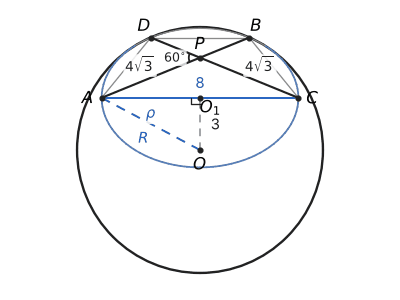
Solution:Let [tex]P[/tex] be the common point of the chords, [tex]O[/tex] the center and [tex]R[/tex] the radius of the sphere. The plane of [tex]AB[/tex] and [tex]CD[/tex] cuts the sphere in a circle [tex]k[/tex] with center [tex]O_1[/tex] (the foot of the perpendicular from [tex]O[/tex]) and radius [tex]\rho[/tex]; from the right triangle [tex]OO_1A[/tex], [tex]R^2=\rho^2+OO_1^2=\rho^2+9[/tex].
By the intersecting chords theorem [tex]PA\times PB=PC\times PD[/tex], and [tex]PA+PB=PC+PD=4\sqrt{3}[/tex]; so [tex]PA[/tex], [tex]PB[/tex] and [tex]PC[/tex], [tex]PD[/tex] are the roots of the same quadratic equation and the two pairs coincide. Renaming [tex]C[/tex] and [tex]D[/tex] if necessary, [tex]PA=PC=x[/tex], [tex]PB=PD=y[/tex], [tex]x+y=4\sqrt{3}[/tex].
Let [tex]\theta=\angle APC=\angle BPD[/tex]; then [tex]\theta=60^{\circ}[/tex] or [tex]\theta=120^{\circ}[/tex]. If [tex]\theta=60^{\circ}[/tex], the isosceles triangles [tex]APC[/tex] and [tex]BPD[/tex] are equilateral, so [tex]AC=x\lt 8[/tex], [tex]BD=y\lt 8[/tex], and by the law of cosines [tex]AD^2=BC^2=x^2+y^2+xy=(x+y)^2-xy\lt 48[/tex]; no segment would be [tex]8[/tex]. Hence [tex]\theta=120^{\circ}[/tex], and by the law of cosines
[tex]AC=x\sqrt{3},\quad BD=y\sqrt{3},\quad AD^2=BC^2=x^2+y^2-xy\le\max(x,y)^2[/tex]
So the longest segment is the larger of [tex]AC[/tex] and [tex]BD[/tex]; let it be [tex]AC[/tex] ([tex]x\ge y[/tex]). Then
[tex]x\sqrt{3}=8\Rightarrow x=\frac{8\sqrt{3}}{3},\quad y=4\sqrt{3}-\frac{8\sqrt{3}}{3}=\frac{4\sqrt{3}}{3}[/tex]
[tex]BD=y\sqrt{3}=4,\quad AD^2=\frac{64}{3}+\frac{16}{3}-\frac{32}{3}=16\Rightarrow AD=4[/tex]
The circle [tex]k[/tex] is the circumcircle of [tex]\triangle ABD[/tex] with [tex]AD=BD=4[/tex], [tex]AB=4\sqrt{3}[/tex]. By the laws of cosines and sines
[tex]\cos\angle ADB=\frac{16+16-48}{2\times 4\times 4}=-\frac{1}{2}\Rightarrow \angle ADB=120^{\circ},\quad \rho=\frac{AB}{2\sin 120^{\circ}}=\frac{4\sqrt{3}}{\sqrt{3}}=4[/tex]
Then [tex]R^2=16+9=25[/tex], [tex]R=5[/tex], and the volume of the ball is
[tex]V=\frac{4}{3}\pi\times 5^3=\frac{500\pi}{3}[/tex]

 MENU
 Easy
 Volume and Surface Area Calculator
