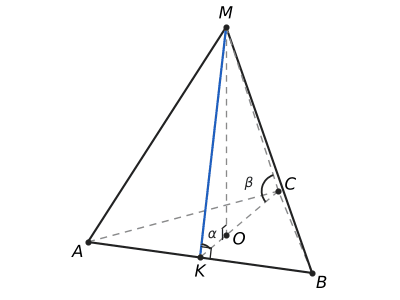
Solution:Let the pyramid be [tex]ABCM[/tex] with base the equilateral triangle [tex]ABC[/tex] and height [tex]MO[/tex]. Since the pyramid is regular, [tex]O[/tex] is the center of [tex]\triangle ABC[/tex], i.e. the intersection point of its medians.
Let [tex]K[/tex] be the midpoint of [tex]AB[/tex]. Then [tex]O[/tex] lies on the median [tex]CK[/tex], and since the centroid divides each median in ratio [tex]2:1[/tex] from the vertex,
[tex]OC=2OK[/tex]
The orthogonal projection of the lateral edge [tex]MC[/tex] on the base is [tex]OC[/tex], so [tex]\angle MCO=\beta[/tex], and from the right triangle [tex]MOC[/tex]:
[tex]\tan \beta=\frac{MO}{OC}[/tex]
The face [tex]ABM[/tex] is an isosceles triangle, so its median [tex]MK[/tex] is also a height: [tex]MK\perp AB[/tex]. Also [tex]OK\perp AB[/tex], since [tex]CK[/tex] is a height of the equilateral triangle [tex]ABC[/tex]. Hence [tex]\angle MKO[/tex] is the linear angle of the dihedral angle at the edge [tex]AB[/tex], i.e. [tex]\angle MKO=\alpha[/tex], and from the right triangle [tex]MOK[/tex]:
[tex]\tan \alpha=\frac{MO}{OK}[/tex]
Therefore
[tex]\tan \alpha=\frac{MO}{OK}=\frac{2MO}{OC}=2\tan \beta[/tex]

 MENU
 Normal
 Volume and Surface Area Calculator
