Prisms and Pyramids Problems: Difficult Problems with Solutions

Problem 1
The base edges of a regular quadrilateral truncated pyramid are [tex]7[/tex] in and [tex]5[/tex] in, and its diagonal is [tex]9[/tex] in. Find the volume of the truncated pyramid (in cubic inches).
Problem 2
A closed container in the shape of a rectangular box holds [tex]90\,000[/tex] cubic inches of water. When the container is placed in turn on three of its faces, no two of which are parallel, the water reaches heights of [tex]30[/tex] in, [tex]37.5[/tex] in and [tex]45[/tex] in, respectively. Find the volume of the container (in thousands of cubic inches).
Problem 3
The lateral surface area of a rectangular box equals [tex]10[/tex], [tex]16[/tex] or [tex]18[/tex], depending on which of its faces is chosen as the base. Find the volume of the box.
Problem 4
In a regular triangular pyramid the lateral edge is [tex]10[/tex] in and the lateral surface area is [tex]144[/tex] square inches. Find all possible values of the length of the base edge of the pyramid (in inches).
Problem 5
The base edges of a regular quadrilateral truncated pyramid are [tex]2[/tex] and [tex]1[/tex], and its height is [tex]3[/tex]. A cross-section parallel to the bases is drawn through the intersection point of the diagonals of the truncated pyramid; it divides the truncated pyramid into two parts. Find the volumes of the two parts (first that of the part containing the larger base).
Problem 6
The base of the pyramid [tex]ABCM[/tex] is the isosceles triangle [tex]ABC[/tex] with base [tex]AB=6[/tex] in and legs [tex]AC=BC=5[/tex] in. All dihedral angles at the base edges of the pyramid are equal to [tex]45^{\circ}[/tex]. Find the volume of the pyramid (in cubic inches).
Problem 7
The area of the base [tex]ABC[/tex] of the regular triangular pyramid [tex]ABCM[/tex] is [tex]25\%[/tex] of its total surface area. The sum of the lengths of all edges of the pyramid is [tex]120[/tex] in. Find the length of a lateral edge of the pyramid (in inches).
Problem 8
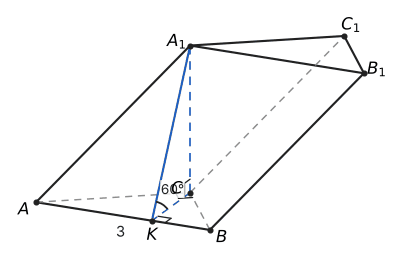
The base [tex]ABC[/tex] of the triangular prism [tex]ABCA_1B_1C_1[/tex] is a right triangle with hypotenuse [tex]AB=3[/tex] and [tex]AC\gt BC[/tex]. The orthogonal projection of the vertex [tex]A_1[/tex] on the plane [tex]ABC[/tex] is the point [tex]C[/tex], and the dihedral angle at the edge [tex]AB[/tex] is [tex]60^{\circ}[/tex]. Find the total surface area of the prism if its volume is [tex]3\sqrt{3}[/tex].
Problem 9
The base of the pyramid [tex]ABCDM[/tex] is the rectangle [tex]ABCD[/tex] with [tex]AB\gt AD[/tex]. The lateral edge [tex]DM[/tex] is perpendicular to the plane of the base, and the other three lateral edges have lengths [tex]13[/tex], [tex]15[/tex] and [tex]5\sqrt{10}[/tex]. Find the total surface area of the pyramid.
Problem 10
The base of the pyramid [tex]ABCDM[/tex] is the trapezoid [tex]ABCD[/tex] ([tex]AB\parallel CD[/tex]) with bases [tex]AB=50[/tex] in and [tex]CD=14[/tex] in and leg [tex]BC=30[/tex] in. All lateral edges of the pyramid are equal to [tex]65[/tex] in. Find the height of the pyramid (in inches).

Problem 11
The perimeter of the base of the rectangular box [tex]ABCDA_1B_1C_1D_1[/tex] is [tex]22[/tex] in, and its lateral edge is [tex]4[/tex] in. The diagonals [tex]A_1B[/tex] and [tex]C_1B[/tex] of two lateral faces have different lengths, and the angle that one of them forms with the plane of the base is half the angle that the other one forms with it. Find the volume of the box (in cubic inches).
Problem 12
The edges of the upper base [tex]A_1B_1C_1D_1[/tex] and the lateral edges of the regular quadrilateral truncated pyramid [tex]ABCDA_1B_1C_1D_1[/tex] are equal. The perimeter of a lateral face is [tex]26[/tex] in, and the slant height of the truncated pyramid is [tex]4[/tex] in. Find the total surface area of the truncated pyramid (in square inches).
Problem 13
In the regular triangular truncated pyramid [tex]ABCA_1B_1C_1[/tex] the base edges are [tex]AB=13[/tex] in and [tex]A_1B_1=1[/tex] in, and the lateral edge is [tex]AA_1=8[/tex] in. Find the volume of the truncated pyramid (in cubic inches).
Problem 14
The lateral edge of an oblique triangular prism [tex]ABCA_1B_1C_1[/tex] is [tex]6[/tex] in long, and two of its lateral faces are perpendicular to each other and have areas [tex]24[/tex] square inches and [tex]30[/tex] square inches. Find the volume of the prism (in cubic inches).
Problem 15
The dihedral angle at an edge of the larger base [tex]ABCD[/tex] of the regular quadrilateral truncated pyramid [tex]ABCDA_1B_1C_1D_1[/tex] is [tex]\alpha[/tex]. The lateral surface area of the truncated pyramid equals the sum of the areas of its two bases. Find the ratio of the perimeter of the larger base to the perimeter of the smaller base.
Problem 16
The lateral edges [tex]DA[/tex], [tex]DB[/tex] and [tex]DC[/tex] of the triangular pyramid [tex]ABCD[/tex] with apex [tex]D[/tex] are pairwise perpendicular. Let [tex]B_1[/tex], [tex]B_2[/tex] and [tex]B_3[/tex] be the areas of the lateral faces [tex]ABD[/tex], [tex]BCD[/tex] and [tex]CAD[/tex], and let [tex]V[/tex] be the volume of the pyramid. Prove that [tex]V=\frac{1}{3}\sqrt{2B_1B_2B_3}[/tex].
Problem 17
The base of the pyramid [tex]SABCD[/tex] is the rhombus [tex]ABCD[/tex] with side [tex]a[/tex] and [tex]\angle BAD=60^{\circ}[/tex], and [tex]SA=a[/tex]. Prove that the segments [tex]SB[/tex], [tex]SC[/tex] and [tex]SD[/tex] can be the sides of a right triangle.
Problem 18
Prove that the sum of the distances from an arbitrary interior point of a regular tetrahedron to its four faces is equal to the height of the tetrahedron.
Problem 19
In a regular quadrilateral pyramid the angle between a lateral face and the base is [tex]\alpha[/tex], and the angle between two adjacent lateral edges is [tex]\gamma[/tex]. Prove that [tex]\cos\alpha=\tan \frac{\gamma}{2}[/tex].
Correct:
Wrong:
Unsolved problems:
Suggest a problem on this page

Feedback   Contact email:
Follow us on   X   Facebook

Copyright © 2005 - 2026.