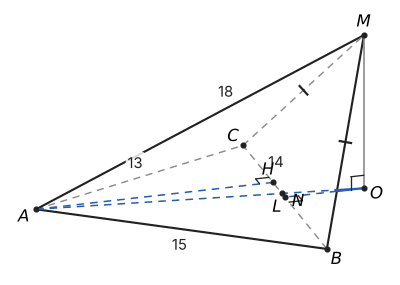
Solution:Let [tex]O[/tex] be the orthogonal projection of [tex]M[/tex] on the plane [tex]ABC[/tex], so [tex]MO[/tex] is the height. The right triangles [tex]MOB[/tex] and [tex]MOC[/tex] have the common leg [tex]MO[/tex] and equal hypotenuses [tex]MB=MC[/tex], so [tex]OB=OC[/tex] and [tex]O[/tex] lies on the perpendicular bisector of [tex]BC[/tex].
Let [tex]OP\perp AB[/tex] and [tex]OQ\perp AC[/tex] ([tex]P[/tex] on the line [tex]AB[/tex], [tex]Q[/tex] on the line [tex]AC[/tex]). By the theorem of three perpendiculars [tex]MP\perp AB[/tex] and [tex]MQ\perp AC[/tex], so [tex]\angle MPO[/tex] and [tex]\angle MQO[/tex] are the angles between the planes [tex]ABM[/tex], [tex]ACM[/tex] and the base. They are equal, so the right triangles [tex]MOP[/tex] and [tex]MOQ[/tex] (common leg [tex]MO[/tex]) are congruent and [tex]OP=OQ[/tex].
A dihedral angle at a base edge is acute when [tex]O[/tex] lies on the same side of that edge as the base, and obtuse when [tex]O[/tex] lies on the other side. Since the dihedral angles at [tex]AB[/tex] and [tex]AC[/tex] are equal and [tex]OP=OQ[/tex], the point [tex]O[/tex] lies in [tex]\angle BAC[/tex] or in its vertical angle, i.e. on the line [tex]AL[/tex] of the bisector of [tex]\angle BAC[/tex] ([tex]L\in BC[/tex]). As [tex]AB\ne AC[/tex], this line meets the perpendicular bisector of [tex]BC[/tex] at exactly one point, and that point is [tex]O[/tex].
Now we work in the base. Let [tex]H[/tex] be the foot of the altitude from [tex]A[/tex] and [tex]N[/tex] the midpoint of [tex]BC[/tex]. From [tex]AB^2-BH^2=AC^2-CH^2[/tex]:
[tex]225-BH^2=169-(14-BH)^2\Rightarrow BH=9,\quad AH=\sqrt{225-81}=12[/tex]
By the angle bisector theorem [tex]\frac{BL}{LC}=\frac{15}{13}[/tex], so [tex]BL=\frac{15}{28}\times 14=\frac{15}{2}[/tex]; also [tex]BN=7[/tex]. Hence the points on [tex]BC[/tex] are in the order [tex]B[/tex], [tex]N[/tex], [tex]L[/tex], [tex]H[/tex] with [tex]NL=\frac{1}{2}[/tex] and [tex]LH=\frac{3}{2}[/tex], and the line [tex]AL[/tex] meets the perpendicular to [tex]BC[/tex] through [tex]N[/tex] at a point [tex]O[/tex] on the other side of [tex]BC[/tex] from [tex]A[/tex]. The right triangles [tex]LHA[/tex] and [tex]LNO[/tex] are similar (vertical angles at [tex]L[/tex]), so
[tex]ON=AH\times \frac{LN}{LH}=12\times \frac{1}{3}=4[/tex]
Let [tex]T[/tex] be the foot of the perpendicular from [tex]A[/tex] to the line [tex]ON[/tex]. Then [tex]AHNT[/tex] is a rectangle, so [tex]AT=HN=2[/tex], [tex]TN=AH=12[/tex] and [tex]TO=TN+NO=12+4=16[/tex], hence
[tex]AO^2=AT^2+TO^2=2^2+16^2=260[/tex]
From the right triangle [tex]AOM[/tex] we find the height, and the base area is [tex]S_{ABC}=\frac{BC\times AH}{2}=\frac{14\times 12}{2}=84[/tex]:
[tex]MO=\sqrt{AM^2-AO^2}=\sqrt{324-260}=8,\quad V=\frac{1}{3}S_{ABC}\times MO=\frac{1}{3}\times 84\times 8=224[/tex]

 MENU
 Easy
 Volume and Surface Area Calculator
