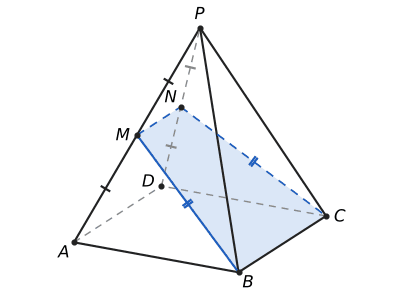
Solution:Since [tex]ABCD[/tex] is a square, [tex]BC\parallel AD[/tex], and [tex]AD[/tex] lies in the plane [tex](ADP)[/tex], hence [tex]BC\parallel(ADP)[/tex]. The plane [tex](BCM)[/tex] contains [tex]BC[/tex] and has the common point [tex]M[/tex] with [tex](ADP)[/tex], so it cuts [tex](ADP)[/tex] along a line through [tex]M[/tex] parallel to [tex]BC[/tex]. This line lies in [tex](ADP)[/tex] and meets [tex]DP[/tex] at [tex]N[/tex], so
[tex]MN\parallel AD\parallel BC[/tex]
In [tex]\triangle ADP[/tex] the segment [tex]MN[/tex] passes through the midpoint [tex]M[/tex] of [tex]AP[/tex] and is parallel to [tex]AD[/tex], so it is a midline: [tex]N[/tex] is the midpoint of [tex]DP[/tex] and
[tex]MN=\frac{AD}{2}=\frac{BC}{2}[/tex]
Thus [tex]MN\parallel BC[/tex] and [tex]MN\ne BC[/tex], so [tex]BMNC[/tex] is a trapezoid with bases [tex]BC[/tex] and [tex]MN[/tex].
The lateral faces [tex]ABP[/tex] and [tex]DCP[/tex] are congruent triangles ([tex]AB=DC[/tex], [tex]PA=PB=PC=PD[/tex]), and [tex]BM[/tex], [tex]CN[/tex] are their corresponding medians to the sides [tex]AP[/tex] and [tex]DP[/tex], so [tex]BM=CN[/tex]. Therefore [tex]BMNC[/tex] is an isosceles trapezoid.

 MENU
 Normal
 Volume of Prisms and Pyramids
