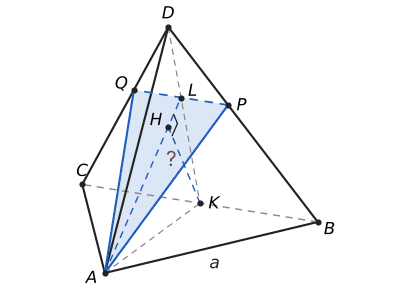
Solution:Let the plane [tex]\alpha[/tex] meet [tex]DB[/tex] and [tex]DC[/tex] at [tex]P[/tex] and [tex]Q[/tex]. Since [tex]BC\parallel\alpha[/tex], the plane [tex](DBC)[/tex] meets [tex]\alpha[/tex] along a line parallel to [tex]BC[/tex], so [tex]PQ\parallel BC[/tex], the triangle [tex]DPQ[/tex] is equilateral and the section is the triangle [tex]APQ[/tex]. Put [tex]DP=DQ=PQ=ta[/tex], [tex]0\lt t\le 1[/tex].
Let [tex]K[/tex] be the midpoint of [tex]BC[/tex]; the median [tex]DK[/tex] meets [tex]PQ[/tex] at its midpoint [tex]L[/tex], and [tex]DL=t\times DK[/tex]. The triangles [tex]ADP[/tex] and [tex]ADQ[/tex] are congruent ([tex]AD[/tex] common, [tex]DP=DQ[/tex], [tex]\angle ADP=\angle ADQ=60^{\circ}[/tex]), so [tex]AP=AQ[/tex] and [tex]AL\perp PQ[/tex].
Next, [tex]BC\perp AK[/tex] and [tex]BC\perp DK[/tex], so [tex]BC\perp(ADK)[/tex]; hence [tex]PQ\perp(ADK)[/tex], and the plane [tex]\alpha[/tex], which contains [tex]PQ[/tex], is perpendicular to [tex](ADK)[/tex] and meets it along the line [tex]AL[/tex]. Since [tex]BC\parallel\alpha[/tex], the points [tex]B[/tex] and [tex]K[/tex] are at the same distance from [tex]\alpha[/tex], and it equals the distance [tex]KH[/tex] from [tex]K[/tex] to the line [tex]AL[/tex] (the perpendicular [tex]KH[/tex] to [tex]AL[/tex] in the plane [tex](ADK)[/tex] is perpendicular to [tex]\alpha[/tex]). As the angle between [tex]AB[/tex] and [tex]\alpha[/tex] is [tex]30^{\circ}[/tex],
[tex]KH=AB\sin 30^{\circ}=\frac{a}{2}[/tex]
In the isosceles triangle [tex]ADK[/tex] we have [tex]AK=DK=\frac{a\sqrt{3}}{2}[/tex], [tex]AD=a[/tex], and the height from [tex]K[/tex] falls at the midpoint of [tex]AD[/tex], so
[tex]h_K=\sqrt{\frac{3a^2}{4}-\frac{a^2}{4}}=\frac{a\sqrt{2}}{2}, \quad S_{ADK}=\frac{1}{2}\times a\times \frac{a\sqrt{2}}{2}=\frac{a^2\sqrt{2}}{4}[/tex]
[tex]\cos\angle ADK=\frac{AD/2}{DK}=\frac{a/2}{a\sqrt{3}/2}=\frac{1}{\sqrt{3}}[/tex]
Since [tex]KL=(1-t)DK[/tex], we have [tex]S_{AKL}=(1-t)S_{ADK}=\frac{(1-t)a^2\sqrt{2}}{4}[/tex], and by the law of cosines in the triangle [tex]ADL[/tex]
[tex]AL^2=a^2+\frac{3t^2a^2}{4}-2\times a\times \frac{ta\sqrt{3}}{2}\times \frac{1}{\sqrt{3}}=a^2\left(1-t+\frac{3t^2}{4}\right)[/tex]
From [tex]KH=\frac{2S_{AKL}}{AL}=\frac{a}{2}[/tex] we get
[tex]\frac{(1-t)a\sqrt{2}}{2\sqrt{1-t+\frac{3t^2}{4}}}=\frac{a}{2}\Rightarrow 2(1-t)^2=1-t+\frac{3t^2}{4}\Rightarrow 5t^2-12t+4=0[/tex]
The roots are [tex]t=2[/tex] and [tex]t=\frac{2}{5}[/tex]; only [tex]t=\frac{2}{5}[/tex] satisfies [tex]t\le 1[/tex]. Then
[tex]PQ=\frac{2a}{5}, \quad AL^2=a^2\left(1-\frac{2}{5}+\frac{3}{25}\right)=\frac{18a^2}{25}, \quad AL=\frac{3\sqrt{2}a}{5}[/tex]
[tex]S_{APQ}=\frac{1}{2}\times PQ\times AL=\frac{1}{2}\times \frac{2a}{5}\times \frac{3\sqrt{2}a}{5}=\frac{3\sqrt{2}a^2}{25}[/tex]

 MENU
 Easy
 Volume of Prisms and Pyramids
