Solution:Substituting the coordinates of the three points:
[tex]\left\{\begin{array}{l} 4a-2b+c=7 \\ a-b+c=3 \\ 9a+3b+c=7 \end{array}\right.[/tex]
Subtracting the first equation from the third gives [tex]5a+5b=0[/tex], i.e. [tex]b=-a[/tex]; then [tex]6a+c=7[/tex] and [tex]2a+c=3[/tex], so [tex]a=1[/tex], [tex]b=-1[/tex], [tex]c=1[/tex] and
[tex]f(x)=x^2-x+1[/tex]
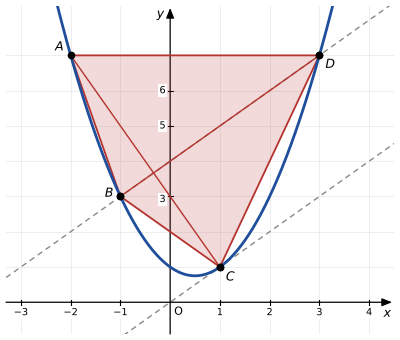
The line [tex]BD[/tex] has slope [tex]\frac{7-3}{3+1}=1[/tex], so its equation is [tex]y=x+4[/tex], and [tex]BD=\sqrt{4^2+4^2}=4\sqrt{2}[/tex]. The diagonal [tex]BD[/tex] divides [tex]ABCD[/tex] into the triangles [tex]ABD[/tex] and [tex]CBD[/tex], and [tex]A[/tex] and [tex]C[/tex] lie on opposite sides of [tex]BD[/tex].
Triangle [tex]ABD[/tex] is fixed: [tex]AD[/tex] lies on the line [tex]y=7[/tex], [tex]AD=5[/tex] and the distance from [tex]B[/tex] to this line is [tex]4[/tex], so
[tex]S_{ABD}=\frac{1}{2}\times 5\times 4=10[/tex]
The point [tex]A[/tex] is above the line [tex]BD[/tex] (at [tex]x=-2[/tex] the line has [tex]y=2\lt 7[/tex]), so [tex]C[/tex] must be below it:
[tex]x^2-x+1\lt x+4\Leftrightarrow (x+1)(x-3)\lt 0\Leftrightarrow -1\lt x\lt 3[/tex]
Let [tex]C\left(t, t^2-t+1\right)[/tex] with [tex]-1\lt t\lt 3[/tex]. Its vertical distance to the line is [tex](t+4)-(t^2-t+1)=4-(t-1)^2[/tex], and since the line makes an angle of [tex]45^\circ[/tex] with the axes, the distance from [tex]C[/tex] to [tex]BD[/tex] is [tex]\frac{4-(t-1)^2}{\sqrt{2}}[/tex]. Hence
[tex]S_{CBD}=\frac{1}{2}\times 4\sqrt{2}\times \frac{4-(t-1)^2}{\sqrt{2}}=2\left(4-(t-1)^2\right)\le 8[/tex]
with equality only for [tex]t=1[/tex], i.e. for [tex]C(1, 1)[/tex] (the point where the tangent [tex]y=x[/tex] is parallel to [tex]BD[/tex]). For [tex]C(1, 1)[/tex] the segments [tex]AC[/tex] and [tex]BD[/tex] meet at [tex]\left(-\frac{1}{3}, \frac{11}{3}\right)[/tex], an interior point of both, so [tex]ABCD[/tex] is indeed a convex quadrilateral with diagonals [tex]AC[/tex] and [tex]BD[/tex]. The greatest area is
[tex]S_{ABCD}=S_{ABD}+S_{CBD}=10+8=18[/tex]

 MENU
 Easy
 Function Graph Plotter
