Difficult

Intercept Theorem: Very Difficult Problems with Solutions

Problem 1
In [tex]\triangle ABC[/tex] the altitude [tex]BD[/tex] ([tex]D\in AC[/tex]) is drawn. The bisectors of [tex]\angle ABD[/tex] and [tex]\angle CBD[/tex] meet [tex]AC[/tex] at the points [tex]E[/tex] and [tex]F[/tex], respectively. If [tex]AE:ED=5:3[/tex], [tex]DF=10[/tex] in and [tex]FC=26[/tex] in, find the perimeter of [tex]\triangle ABC[/tex] in inches.
Problem 2
Through the intersection point of the angle bisectors of an isosceles triangle a line parallel to the base is drawn. The segment of this line between the legs is [tex]6[/tex] in, and the perimeter of the triangle is [tex]32[/tex] in. Find the base of the triangle in inches.
Problem 3
The angle bisector [tex]CM[/tex] ([tex]M\in AB[/tex]) of [tex]\triangle ABC[/tex] is a chord of a circle whose center lies on the line [tex]AB[/tex]. Find the diameter of the circle in inches if [tex]AM=12[/tex] in and [tex]BM=3[/tex] in.
Problem 4
In [tex]\triangle ABC[/tex] the segment joining the centroid and the incenter is parallel to the side [tex]AC[/tex]. If [tex]AC=1[/tex] ft, find the perimeter of the triangle in feet.
Problem 5
In the parallelogram [tex]ABCD[/tex] the diagonals are [tex]AC=27[/tex] and [tex]BD=12[/tex]. Through the centroids of the triangles [tex]ABC[/tex] and [tex]ADC[/tex] lines parallel to the diagonal [tex]AC[/tex] are drawn. Find the perimeter of the quadrilateral whose vertices are the intersection points of these lines with the sides of the parallelogram.
Problem 6
The point [tex]D[/tex] lies on the side [tex]AC[/tex] of [tex]\triangle ABC[/tex] with [tex]AD:DC=4:5[/tex], and the point [tex]O[/tex] lies on the segment [tex]BD[/tex] with [tex]BO:OD=3:2[/tex]. The line [tex]AO[/tex] meets the side [tex]BC[/tex] at the point [tex]K[/tex]. Find the ratio [tex]BK:KC[/tex].
Problem 7
The bisector of the angle at the vertex [tex]A[/tex] of [tex]\triangle ABC[/tex] meets the side [tex]BC[/tex] at the point [tex]L[/tex]. Find the angles of the triangle if [tex]AB=2AC[/tex] and [tex]AL=2CL[/tex].
Problem 8
The leg of an isosceles triangle is [tex]30[/tex] in. The altitude to its base is divided into three equal parts, and lines are drawn through the division points and one of the base vertices. Find the segments into which these lines divide the opposite leg of the triangle (listed from the apex), in inches.
Problem 9
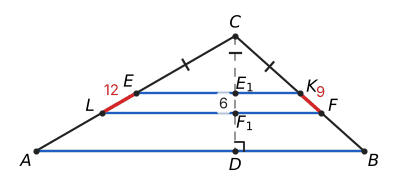
On the sides [tex]CA[/tex] and [tex]CB[/tex] of [tex]\triangle ABC[/tex] the segments [tex]CE[/tex] and [tex]CF[/tex] are laid off, each equal to the altitude [tex]CD[/tex] of the triangle. Through [tex]E[/tex] and [tex]F[/tex] lines parallel to [tex]AB[/tex] are drawn, and the distance between them is [tex]6[/tex] in. The two lines cut off from the side [tex]CA[/tex] a segment (between them) of length [tex]12[/tex] in, and from the side [tex]CB[/tex] a segment of length [tex]9[/tex] in. Find [tex]CA[/tex] and [tex]CB[/tex] in inches.
Problem 10
[tex]ABCD[/tex] [tex](AB\parallel CD)[/tex] is a trapezoid with bases [tex]AB=a[/tex] and [tex]CD=b[/tex]. The point [tex]O[/tex] is the intersection point of the diagonals. A line through [tex]O[/tex] parallel to the bases meets the legs [tex]AD[/tex] and [tex]BC[/tex] at the points [tex]M[/tex] and [tex]N[/tex], respectively. Prove that [tex]MN=\frac{2ab}{a+b}[/tex].

Problem 11
A line passes through the midpoint of the side [tex]AB[/tex] of [tex]\triangle ABC[/tex] and meets the rays [tex]CA[/tex] and [tex]CB[/tex] at the points [tex]M[/tex] and [tex]N[/tex], respectively. Prove that [tex]\frac{CA}{CM}+\frac{CB}{CN}=2[/tex].
Problem 12
An arbitrary point [tex]M[/tex] is taken on the side [tex]BC[/tex] of the parallelogram [tex]ABCD[/tex]. The lines [tex]AM[/tex] and [tex]DC[/tex] meet at the point [tex]N[/tex], and [tex]P[/tex] is the midpoint of the segment [tex]MN[/tex]. The line [tex]CP[/tex] meets the lines [tex]AD[/tex] and [tex]AB[/tex] at the points [tex]R[/tex] and [tex]Q[/tex], respectively. Prove that [tex]PQ=PR[/tex].
Problem 13
The segment [tex]CM[/tex] is a median of [tex]\triangle ABC[/tex], and [tex]P[/tex] is an interior point of [tex]CM[/tex]. The line [tex]AP[/tex] meets [tex]BC[/tex] at the point [tex]A_1[/tex], and the line [tex]BP[/tex] meets [tex]AC[/tex] at the point [tex]B_1[/tex]. Prove that if [tex]AA_1=BB_1[/tex], then [tex]AC=BC[/tex].
Correct:
Wrong:
Unsolved problems:
Difficult
Suggest a problem on this page

Feedback   Contact email:
Follow us on   X   Facebook

Copyright © 2005 - 2026.