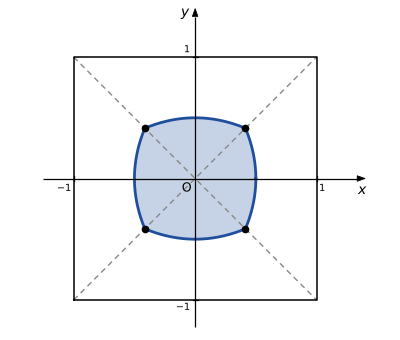
Solution:The answer does not depend on the size of the square, so take the square [tex]-1\le x\le 1[/tex], [tex]-1\le y\le 1[/tex] with center [tex]O(0, 0)[/tex]. The coordinate axes and the diagonals cut it into [tex]8[/tex] congruent triangles, and the condition is symmetric with respect to these lines, so it suffices to work in the triangle
[tex]T:\ 0\le y\le x\le 1 , \quad S_T=\frac{1}{2}[/tex]
In [tex]T[/tex] the nearest side is [tex]x=1[/tex], at distance [tex]1-x\ge 0[/tex]. Both sides of the inequality are nonnegative, so we may square:
[tex]\sqrt{x^2+y^2}\lt 1-x\iff x^2+y^2\lt 1-2x+x^2\iff x\lt\frac{1-y^2}{2}[/tex]
Together with [tex]x\ge y[/tex] this requires [tex]y\lt\frac{1-y^2}{2}[/tex], i.e. [tex]y^2+2y-1\lt 0[/tex], so [tex]0\le y\lt\sqrt{2}-1[/tex]. Let [tex]t=\sqrt{2}-1[/tex]; the favorable area in [tex]T[/tex] is
[tex]S=\int_0^{t}\left(\frac{1-y^2}{2}-y\right)dy=\frac{t}{2}-\frac{t^3}{6}-\frac{t^2}{2}=\frac{3t-t^3-3t^2}{6}[/tex]
Since [tex]t^2=3-2\sqrt{2}[/tex] and [tex]t^3=5\sqrt{2}-7[/tex], we get
[tex]S=\frac{3\sqrt{2}-3-5\sqrt{2}+7-9+6\sqrt{2}}{6}=\frac{4\sqrt{2}-5}{6}[/tex]
The probability is the ratio of the areas:
[tex]P=\frac{S}{S_T}=\frac{4\sqrt{2}-5}{3}\approx 0.22[/tex]

 MENU
 Easy
 Statistics Calculator
