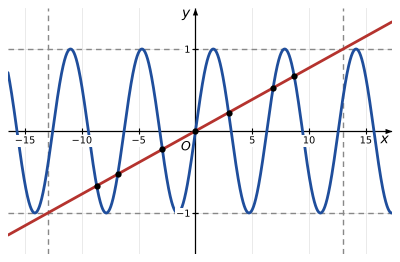
Solution:The solutions are the abscissas of the common points of the sine curve [tex]y=\sin x[/tex] and the line [tex]y=\frac{x}{13}[/tex]. Both functions are odd, so the solutions are symmetric about [tex]0[/tex]: [tex]x=0[/tex] is a solution, and it suffices to count the positive solutions and double their number.
Since [tex]\left|\sin x\right|\le 1[/tex], every solution satisfies [tex]\left|x\right|\le 13[/tex]. For [tex]x\gt 0[/tex] on the intervals [tex]\left[\pi, 2\pi\right][/tex] and [tex]\left[3\pi, 4\pi\right][/tex] we have [tex]\sin x\le 0\lt\frac{x}{13}[/tex], so there are no solutions there. Note that [tex]4\pi\lt 13\lt\frac{9\pi}{2}[/tex], because [tex]\frac{26}{9}\lt\pi\lt\frac{13}{4}[/tex].
Let [tex]h(x)=\sin x-\frac{x}{13}[/tex]. Where [tex]\sin x\gt 0[/tex], we have [tex]h''(x)=-\sin x\lt 0[/tex], so [tex]h[/tex] is concave there and has at most two zeros on each such interval (a line meets each arch of the sine curve in at most two points).
On [tex]\left[0, \pi\right][/tex]:
[tex]h(0)=0,\qquad h'(0)=1-\frac{1}{13}\gt 0,\qquad h(\pi)=-\frac{\pi}{13}\lt 0[/tex]
The sine curve starts above the line and ends below it, so besides [tex]x=0[/tex] there is a zero in [tex]\left(0, \pi\right)[/tex], and since [tex]h[/tex] has at most two zeros on [tex]\left[0, \pi\right][/tex], there is exactly one solution in [tex]\left(0, \pi\right)[/tex].
On [tex]\left[2\pi, 3\pi\right][/tex] (using [tex]5\pi\lt 26[/tex]):
[tex]h(2\pi)=-\frac{2\pi}{13}\lt 0,\qquad h\left(\frac{5\pi}{2}\right)=1-\frac{5\pi}{26}\gt 0,\qquad h(3\pi)=-\frac{3\pi}{13}\lt 0[/tex]
so there is a zero in each of [tex]\left(2\pi, \frac{5\pi}{2}\right)[/tex] and [tex]\left(\frac{5\pi}{2}, 3\pi\right)[/tex], and at most two in total: exactly two solutions.
On [tex]\left[4\pi, 13\right][/tex], using [tex]\sin t\le t[/tex] for [tex]t\ge 0[/tex] and [tex]\frac{25}{8}\lt\pi[/tex]:
[tex]\sin x=\sin (x-4\pi)\le x-4\pi\le 13-4\pi\lt\frac{1}{2}\lt\frac{12}{13}\lt\frac{4\pi}{13}\le\frac{x}{13}[/tex]
so there are no solutions there. Thus there are [tex]1+2=3[/tex] positive solutions, [tex]3[/tex] negative ones and [tex]x=0[/tex]:
[tex]3+3+1=7[/tex]

 MENU
 Easy
 Function Graph Plotter
