
 MENU
MENUTrigonometry - Sin, Cos, Tan, Cot
A circle centered at the origin of the coordinate system and with a radius of 1 is known as a unit circle.
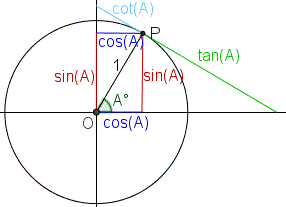
If P is a point from the circle and A is the angle between PO and x axis then:
The x-coordinate of P is called the cosine of A and is denoted by cos A;
The y-coordinate of P is called the sine of A and is denoted by sin A;
The number $\frac{\sin(A)}{\cos(A)}$ is called the tangent of A and is denoted by tan A;
The number $\frac{\cos(A)}{\sin(A)}$ is called the cotangent of A and is denoted by cot A.
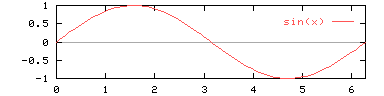
The sine function
sin: R -> R
All trigonometric functions are periodic. The period of sine is $2\pi$.
The range of the function is [-1,1].
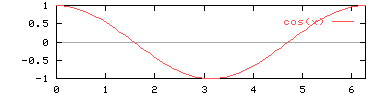
The cosine function
cos: R -> R
The period of cosine is $2\pi$.
The range of the function is [-1,1].
The tangent function
tan : R -> R
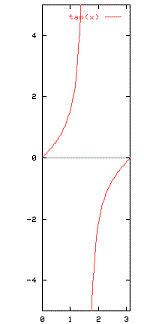
The range of the function is R.
The period is $\pi$ and the tangent function is undefined at $x = \frac{\pi}{2} + k\pi$, k=0,1,2,...
Here is the graph of the tangent function on the interval $0 - \pi$
Animated graph (opens in a new window):
The graph of tangent function on the interval $0\ -\ 2\pi$
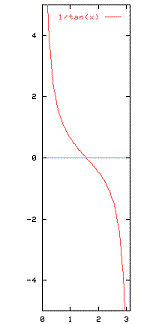
The cotangent function
cot : R -> R
The range of the function is R.
The period is $\pi$ and that the function is undefined at $x = k\pi$, k=0,1,2,...
The values of sin, cos, tan, cot at the angles of 0°, 30°, 60°, 90°, 120°, 135°, 150°, 180°, 210°, 225°, 240°, 270°, 300°, 315°, 330°, 360°
The easiest way to remember the basic values of sin and cos
at the angles of 0°, 30°, 60°, 90°:
sin([0, 30, 45, 60, 90]) = cos([90, 60, 45, 30, 0]) = sqrt([0, 1, 2, 3, 4]/4)
Basic Trigonometric Identities
For every angle $\alpha$ corresponds exactly one point $P(\cos(\alpha),\sin(\alpha))$ on the unit circle.
If the sum of two angles $\alpha$ and $\beta$ is 180 (i.e. $\alpha + \beta = 180^{\circ}$) then:
- $\sin(\alpha) = \sin(\beta)$
- $\cos(\alpha) = -\cos(\beta)$
- $\tan(\alpha) = -\tan(\beta)$
- $\cot(\alpha) = -\cot(\beta)$
If the sum of two angles $\alpha$ and $\beta$ is 90 (i.e. $\alpha + \beta = 90^{\circ}$) then:
- $\sin(\alpha) = \cos(\beta)$
- $\cos(\alpha) = \sin(\beta)$
- $\tan(\alpha) = \cot(\beta)$
- $\cot(\alpha) = \tan(\beta)$
Trigonometric Formulas
Half-Angle Formulas
$\sin\frac{\alpha}{2}=\pm\sqrt{\frac{1-\cos \alpha}{2}}$
+ (positive) if $\frac{\alpha}{2}$ lies in quadrant | or ||
- (negative) if $\frac{\alpha}{2}$ lies in quadrant ||| or |V
$\cos\frac{\alpha}{2}=\pm\sqrt{\frac{1+\cos \alpha}{2}}$
+ (positive) if $\frac{\alpha}{2}$ lies in quadrant | or |V
- (negative) if $\frac{\alpha}{2}$ lies in quadrant || or |||
$\tan\frac{\alpha}{2}=\pm\sqrt{\frac{1-\cos \alpha}{1+\cos \alpha}}$
+ (positive) if $\frac{\alpha}{2}$ lies in quadrant | or |||
- (negative) if $\frac{\alpha}{2}$ lies in quadrant || or |V
$\cot\frac{\alpha}{2}=\pm\sqrt{\frac{1+\cos \alpha}{1-\cos \alpha}}$
+ (positive) if $\frac{\alpha}{2}$ lies in quadrant | or |||
- (negative) if $\frac{\alpha}{2}$ lies in quadrant || or |V
$\tan\frac{\alpha}{2} = \frac{\sin \alpha}{1+\cos \alpha} = \frac{1-\cos \alpha}{\sin \alpha}=\csc \alpha-\cot \alpha$
$\cot\frac{\alpha}{2} = \frac{\sin \alpha}{1-\cos \alpha} = \frac{1+\cos \alpha}{\sin \alpha}=\csc \alpha+\cot \alpha$
Double and Triple Angle Formulas
$\sin(2\alpha) = 2\sin(\alpha)\cdot \cos(\alpha)$
$\cos(2\alpha) = \cos^2(\alpha) - \sin^2(\alpha) = 2\cos^2(\alpha) - 1 = 1 - 2\sin^2(\alpha)$
$\tan(2\alpha) = \frac{2\tan(\alpha)}{1- \tan^2(\alpha)}$
$\cos(2\alpha) = \frac{1 - \tan^2(\alpha)}{1 + \tan^2(\alpha)}$
$\sin(2\alpha) = \frac{2\tan(\alpha)}{1 + \tan^2(\alpha)}$
$\sin3\alpha = 3\sin \alpha - 4 \sin^3\alpha$
$\cos3\alpha = 4\cos^3\alpha - 3 \cos \alpha$
$\tan3\alpha=\frac{3\tan \alpha - \tan^3\alpha}{1-3\tan^2\alpha}$
$\cot3\alpha=\frac{\cot^3\alpha-3\cot \alpha}{3\cot^2\alpha-1}$
$\sin4\alpha = 4\cos^3A\cdot \sin \alpha - 4\cos \alpha\cdot \sin^3\alpha$
$\cos4\alpha = \cos^4\alpha - 6\cos^2\alpha\cdot \sin^2\alpha + \sin^4\alpha$
$\tan4\alpha=\frac{4\tan \alpha - 4\tan^3A}{1-6\tan^2\alpha+\tan^4\alpha}$
$\cot4\alpha=\frac{\cot^4\alpha-6\cot^2\alpha+1}{4\cot^3\alpha-4\cot \alpha}$
Power-Reducing Formulas
$\sin^2(\alpha)=\frac{1 - \cos(2\alpha)}{2}$
$\sin^3(\alpha)=\frac{3\sin \alpha - \sin(3\alpha)}{4}$
$\sin^4(\alpha)=\frac{\cos(4\alpha) - 4\cos(2\alpha) + 3}{8}$
$\cos^2(\alpha) = \frac{1 + \cos(2\alpha)}{2}$
$\cos^3(\alpha)=\frac{3\cos \alpha + \cos(3\alpha)}{4}$
$\cos^4(\alpha)=\frac{4\cos(2\alpha) + \cos(4\alpha) + 3}{8}$
Sum and Difference of Angles
$\sin(\alpha + \beta) = \sin(\alpha)\cdot \cos(\beta) + \cos(\alpha)\cdot \sin(\beta)$
$\sin(\alpha - \beta) = \sin(\alpha)\cdot \cos(\beta) - \cos(\alpha)\cdot \sin(\beta)$
$\cos(\alpha + \beta) = \cos(\alpha)\cdot \cos(\beta) - \sin(\alpha)\cdot \sin(\beta)$
$\cos(\alpha - \beta) = \cos(\alpha)\cdot \cos(\beta) + \sin(\alpha)\cdot \sin(\beta)$
$\tan(\alpha + \beta) = \frac{\sin(\alpha + \beta)}{\cos(\alpha + \beta)}=\frac{\sin(\alpha)\cdot \cos(\beta) + \cos(\alpha)\cdot \sin(\beta)}{\cos(\alpha)\cdot \cos(\beta) - \sin(\alpha)\cdot \sin(\beta)}$
$\tan(\alpha + \beta) = \frac{\tan(\alpha) + \tan(\beta)}{1 - \tan(\alpha)\cdot\tan(\beta)}$
$\cot(\alpha \pm \beta) = \frac{\cot(\beta)\cot(\alpha)\mp 1}{\cot(\beta)\pm \cot(\alpha)}=\frac{1\mp \tan(\alpha)\tan(\beta)}{\tan(\alpha)\pm \tan(\beta)}$
$\sin(\alpha + \beta + \gamma) = \sin \alpha\cdot\cos \beta\cdot\cos \gamma + \cos \alpha\cdot\sin \beta\cdot\cos \gamma + \cos \alpha\cdot\cos \beta\cdot\sin \gamma - \sin \alpha\cdot\sin \beta\cdot\sin \gamma$
$\cos(\alpha + \beta + \gamma) = \cos \alpha\cdot\cos \beta\cdot\cos \gamma - \sin \alpha\cdot\sin \beta\cdot\cos \gamma - \sin \alpha\cdot\cos \beta\cdot\sin \gamma $
$- \sin \alpha\cdot\cos \beta \cdot\sin \gamma - \cos \alpha \cdot \sin \beta\cdot \sin \gamma$
$\tan(\alpha + \beta + \gamma) = \frac{\tan \alpha + \tan \beta + \tan \gamma - \tan \alpha\cdot \tan \beta \cdot \tan \gamma}{1 - \tan \alpha \cdot\tan \beta - \tan \beta\cdot\tan \gamma - \tan \alpha\cdot\tan \gamma}$
Sum and Difference of Trigonometric Functions
$\textrm{ sin } \alpha + \textrm{ sin }\beta = 2 \textrm{ sin }\frac{\alpha + \beta}{2} \textrm{ cos }\frac{\alpha - \beta}{2}$
$\textrm{ sin } \alpha - \textrm{ sin }\beta = 2 \textrm{ sin }\frac{\alpha - \beta}{2} \textrm{ cos }\frac{\alpha + \beta}{2}$
$\textrm{ cos } \alpha + \textrm{ cos }\beta = 2 \textrm{ cos }\frac{\alpha + \beta}{2} \textrm{ cos }\frac{\alpha - \beta}{2}$
$\textrm{ cos } \alpha - \textrm{ cos }\beta = -2 \textrm{ sin }\frac{\alpha + \beta}{2} \textrm{ sin }\frac{\alpha - \beta}{2}$
$\tan \alpha + \tan \beta = \frac{\sin(\alpha+\beta)}{\cos \alpha \cdot\cos \beta}$
$\tan \alpha - \tan \beta = \frac{\sin(\alpha-\beta)}{\cos \alpha\cdot\cos \beta}$
$\cot \alpha + \cot \beta = \frac{\sin(\alpha+\beta)}{\sin \alpha\cdot\sin \beta}$
$\cot \alpha - \cot \beta = \frac{-\sin(\alpha-\beta)}{\sin \alpha\cdot\sin \beta}$
Multiplication of 2 Trigonometric Functions
$\textrm{ sin }\alpha \textrm{ sin }\beta = \frac{1}{2} (\textrm{ cos }(\alpha - \beta) - \textrm{ cos }(\alpha + \beta))$
$\textrm{ cos }\alpha \textrm{ cos }\beta = \frac{1}{2} (\textrm{ cos }(\alpha - \beta) + \textrm{ cos }(\alpha + \beta))$
$\textrm{ sin }\alpha \textrm{ cos }\beta = \frac{1}{2} (\textrm{ sin }(\alpha + \beta) + \textrm{ sin }(\alpha - \beta))$
$\tan \alpha \cdot \tan \beta = \frac{\tan \alpha+\tan \beta}{\cot \alpha+\cot \beta}=-\frac{\tan \alpha-\tan \beta}{\cot \alpha-\cot \beta}$
$\cot \alpha \cdot \cot \beta = \frac{\cot \alpha+\cot \beta}{\tan \alpha+\tan \beta}$
$\tan \alpha \cdot \cot \beta = \frac{\tan \alpha+\cot \beta}{\cot \alpha+\tan \beta}$
$\sin \alpha\sin \beta\sin \gamma = \frac{1}{4}\big(\sin(\alpha+\beta-\gamma)+\sin(\beta+\gamma-\alpha)+\sin(\gamma+\alpha-\beta)-\sin(\alpha+\beta+\gamma)\big)$
$\cos \alpha\cos \beta\cos \gamma = \frac{1}{4}\big(\cos(\alpha+\beta-\gamma)+\cos(\beta+\gamma-\alpha)+\cos(\gamma+\alpha-\beta)+\cos(\alpha+\beta+\gamma)\big)$
$\sin \alpha\sin \beta\cos \gamma = \frac{1}{4}\big(-\cos(\alpha+\beta-\gamma)+\cos(\beta+\gamma-\alpha)+\cos(\gamma+\alpha-\beta)-\cos(\alpha+\beta+\gamma)\big)$
$\sin \alpha\cos \beta\cos \gamma = \frac{1}{4}\big(\sin(\alpha+\beta-\gamma)-\sin(\beta+\gamma-\alpha)+\sin(\gamma+\alpha-\beta)+\sin(\alpha+\beta+\gamma)\big)$
Tangent half-angle substitution
$\sin \alpha = \frac{2\tan\frac{\alpha}{2}}{1+\tan^2\frac{\alpha}{2}}$
$\cos \alpha = \frac{1-\tan^2\frac{\alpha}{2}}{1+\tan^2\frac{\alpha}{2}}$
$\tan \alpha = \frac{2\tan\frac{\alpha}{2}}{1-\tan^2\frac{\alpha}{2}}$
$\cot \alpha = \frac{1-\tan^2\frac{\alpha}{2}}{2\tan\frac{\alpha}{2}}$
Other Trigonometric Formulas
$1\pm\sin \alpha=2\sin^2\big(\frac{\pi}{4}\pm \frac{\alpha}{2}\big)=2\cos^2\big(\frac{\pi}{4}\mp \frac{\alpha}{2}\big)$
$\frac{1-\sin \alpha}{1+\sin \alpha} = \tan^2(\frac{\pi}{4}-\frac{\alpha}{2})$
$\frac{1-\cos \alpha}{1+\cos \alpha} = \tan^2\frac{\alpha}{2}$
$\frac{1-\tan \alpha}{1+\tan \alpha} = \tan(\frac{\pi}{4}-\alpha)$
$\frac{1+\tan \alpha}{1-\tan \alpha} = \tan(\frac{\pi}{4}+\alpha)$
$\frac{\cot \alpha + 1}{\cot \alpha - 1} = \cot(\frac{\pi}{4}-\alpha)$
$\tan \alpha + \cot \alpha = \frac{2}{\sin2\alpha}$
$\tan \alpha - \cot \alpha = -2\cot2\alpha$

