
 MENU
MENUBi-Quadratic Equations
A bi-quadratic equation is a fourth-degree polynomial equation that contains only even powers of the variable.
Definition
The general form is:
$ax^4 + bx^2 + c = 0$
where:
$(a \neq 0)$
$a, b, c$ are real numbers
There are no $x^3$ or $x$ terms. Because only even powers appear, the equation can be reduced to a quadratic equation.
Main Idea: Substitution
Let:
$u = x^2$
Then the equation becomes:
$au^2 + bu + c = 0$
This is a standard quadratic equation.
After solving it, we return to:
$x^2 = u$
Since we are working in the real numbers, we must remember:
$x^2 \ge 0$
Negative values of $u$ do not produce real solutions.
General Solution Procedure
Step 1: Substitute $u = x^2$
Step 2: Solve the quadratic equation in $u$
Step 3: Keep only solutions where $u \ge 0$
Step 4: Solve
$x = \pm \sqrt{u}$
Example 1 — Four Real Solutions
Solve:
$x^4 - 5x^2 + 4 = 0$
Substitute: $u^2 - 5u + 4 = 0$
Factor:
$(u - 4)(u - 1) = 0$
$u = 4 \quad \text{or} \quad u = 1$
Both are nonnegative.
Back-substitute:
$x^2 = 4 \Rightarrow x = \pm 2$
$x^2 = 1 \Rightarrow x = \pm 1$
Solutions:
$x = -2, -1, 1, 2$
Example 2 — Two Real Solutions (One Positive, One Negative Value of $u$)
Solve:
$x^4 - x^2 - 6 = 0$
Substitute: $u^2 - u - 6 = 0$
Factor: $ (u - 3)(u + 2) = 0$
$u = 3 \quad \text{or} \quad u = -2$
Since $x^2 \ge 0$, we reject $u = -2$.
Solve the valid case:
$x^2 = 3$
$x = \pm \sqrt{3}$
Solutions: $x = -\sqrt{3}, \quad \sqrt{3}$
Example 3 — Three Real Solutions (One Repeated Root)
Solve: $x^4 - 4x^2 = 0$
Factor: $x^2(x^2 - 4) = 0$
$x^2 = 0 \quad \text{or} \quad x^2 = 4$
Solve:
$x = 0$
$x = \pm 2$
Solutions:
$x = -2, 0, 2$
Here, $x = 0$ is a repeated root.
All roots are: $-2, 0, 0, 2$
Example 4 — No Real Solutions
Solve: $x^4 + 4x^2 + 5 = 0$
Substitute: $u^2 + 4u + 5 = 0$
Discriminant: $\Delta = 16 - 20 = -4$
Since the quadratic has no real solutions, the original equation has no real solutions.
Using the Quadratic Formula
When the quadratic in $u$ does not factor with integers, use the quadratic formula:
$u = \dfrac{-b \pm \sqrt{b^2 - 4ac}}{2a}$
Example 5 — Irrational Solutions
Solve:
$x^4 - 6x^2 + 4 = 0$
Substitute: $u^2 - 6u + 4 = 0$
This does not factor with integers, so apply the quadratic formula:
$u = \dfrac{6 \pm \sqrt{36 - 16}}{2} = \dfrac{6 \pm \sqrt{20}}{2} = 3 \pm \sqrt{5}$
Both values are positive, since $\sqrt{5} \approx 2.24$ gives $u \approx 5.24$ and $u \approx 0.76$.
Back-substitute:
$x = \pm\sqrt{3 + \sqrt{5}} \quad \text{and} \quad x = \pm\sqrt{3 - \sqrt{5}}$
Solutions: four real solutions (all irrational).
Summary of All Possible Cases
Let the quadratic in $u$ have solutions $u_1$ and $u_2$.
| Values of $u$ | Real solutions of bi-quadratic equation |
| both positive | 4 real solutions |
| one positive, one negative | 2 real solutions |
| one positive, one zero | 3 real solutions (one repeated) |
| one zero, one negative | 1 real solution |
| both negative | 0 real solutions |
| no real values of $u$ | 0 real solutions |
Graphical Interpretation
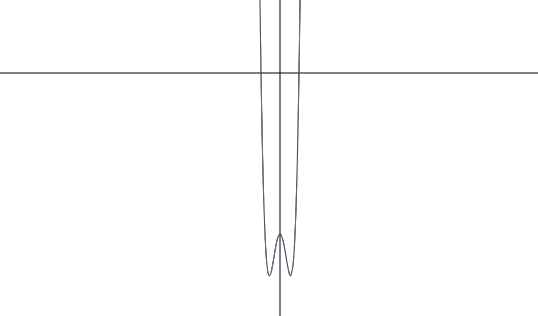
The function $f(x) = ax^4 + bx^2 + c$
is symmetric about the y-axis because:
$f(x) = f(-x)$
The real solutions correspond to the points where the graph intersects the x-axis.
Practice Exercises
Solve each bi-quadratic equation. Try them yourself, then check your answers below.
1. $x^4 - 10x^2 + 9 = 0$
2. $x^4 - 13x^2 + 36 = 0$
3. $x^4 - 2x^2 - 8 = 0$
4. $x^4 - 9x^2 = 0$
5. $x^4 + 3x^2 + 2 = 0$
Answers
1. $x = -3, -1, 1, 3$
2. $x = -3, -2, 2, 3$
3. $x = -2, 2$
4. $x = -3, 0, 3$
5. no real solutions
 Quadratic Equations