MENU
MENUExponents
When you multiply a by itself, it's easy to write it down as a × a. However, when you have to multiply a by itself, let's say, forty five times, you need to write a very long line, which is inconvenient. You can use a shorter notation instead, called exponent (power).
Remember that exponent can be used only when multiplying a number or a variable by itself. Then, instead of writing your number 45 times in a row, you can simply write a45.
The superscript, in this case 45, indicates the number of multipliers in the function, and it's called an exponent, and a is called a base.
An exponent can take both positive and negative values. When it's negative, the following rule applies:
$x^{-a} = \frac{1}{x^a}$,
but to avoid dividing by zero the value of x must be non-zero.
The exponents can be both rational or irrational. When the exponent is fractional, for example $\frac34$, this means that you have to take the 4-th degree root of x3. For more details read materials for radicals.
Laws of Exponents
Here are the basic properties, which you have to remember.
| a-n | = |
|
$a^{\frac{1}{n}}=\sqrt[n]{a}$
an × am =
a × a × a × a × a...(n times) × a × a × a × a × a.....(m times),
which is equal to a × a × a × a × a....(n + m times)
or
am + n
|
= | an-m |
a must be non-zero.
If you have (an)m, this means (a × a × a × a × a...(n times)) × (a × a × a × a × a...(n times)) × (a × a × a × a × a...(n times)) ...... (m times).
In this case the number of multipliers is n times m and (an)m equals am × n.
If you have (a × b)n this is the same as (a × b) × (a × b) × (a × b)....(n times), which
equals
(a × a × a × a × a...(n times)) × (b × b × b × b × b....(n times)) or an × bn.
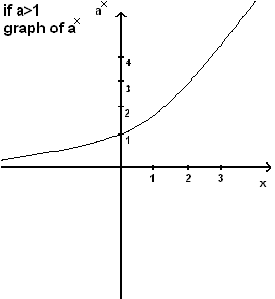
Monotony of exponential function
An exponential function is a function of the form
If 0 < a < b then:
if x > 0 => ax < bx
if x < 0 => ax > bx
if 0 ≤ a < 1 => ax > ay
if a > 1 => ax < ay