
 MENU
MENUBasic Differential Equations and Solutions
Separation of variables
f1(x)g1(y)dx + f2(x)g2(y)dy = 0
Solution
$\int\frac{f_1(x)}{f_2(x)}dx + \int\frac{g_2(y)}{g_1(y)}dy = c$
Linear first order eqaution
dx/dy + P(x)y = Q(x)
Solution
$y e^{\int P dx} = \int Q e^{\int P dx} dx + c$
Bernoulli's equation
dy/dx + P(x)y = Q(x)yn
Solution
$v e^{(1-n) \int P dx} = (1-n) \int Q e^{(1-n) \int P dx} dx + c$
where v = y1-n.
If n = 1, the solution is
$ln y = \int (Q - P ) dx + c$
Exact equation
M(x,y)dx + N(x,y)dy = 0, where ∂M/∂y = ∂N/∂x.
Solution
$\int M \partial x + \int (N - \frac{\partial}{\partial y}\int M \partial x) dy = c$
where ∂x indicates that the integration is to be performed with respect to x keeping y constant.
Homogeneous equation
dy/dx = F(y/x).
Solution
$ln x = \int \frac{dv}{F(v) - v} + c$where v = y/x.If F(v) = v, the solution is y = cx.
yF(xy)dx + xG(xy)dy = 0
Solution
$ln x = \int \frac{G(v) dv}{v \{G(v) - F(v)\} } + c$where v = xy. If G(v) = F(v), the solution is xy = c.
Linear, homogeneous second order eqaution
d2y/dx2 + a(dy/dx) + by = 0 , a,b are real constant.
Solution
Let m1, m2 are roots of m2 + am + b = 0.Then there are three cases
Case 1. m1,m2 real and distinct:
$y = c_1 e^{m_1 x} + c_2 e^{m_2 x}$
Case 2. m1,m2 real and equal:
$y = c_1 e^{m_1 x} + c_2 x e^{m_1 x}$
Case 3. m1 = p + qi,m2 = p - qi:
$y = e^{px} (c_1 \cos qx + c_2 \sin qx)$
Linear, nonhomogeneous second order equation
d2y/dx2 + a(dy/dx) + by = R(x), a, b are real constants.
Solution
There are three cases corresponding to the above ones.
Case 1
Case 2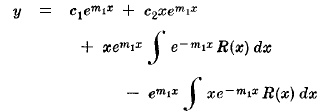
Case 3
Euler or Cauchy equation
x2d2y/dx2 + a(dy/dx) + by = S(x) .
Solution
Putting x = et, the equation becomes
d2y/dt2 + (a - 1)(dy/dt) + by = S(et)
and can then be solved as the above two entries.
Bessel's equation
x2d2y/dx2 + x(dy/dx) + (λ2x2 - n2)y = 0.
Solution
y = c1Jn(λx) + c2Yn(x).
Transformed Bessel's equation
x2d2y/dx2 + (2p + 1)x(dy/dx) + (α2x2r + β2)y = 0.
Solution
$y = x^{-p} \{c_1 J_{q/r} (\frac{\alpha}{\gamma}x^r) + c_2 Y_{q/r} (\frac{\alpha}{\gamma}x^r)\}$
where q = √p2 - β2.
Legendre'e equation
(1 - x2)d2y/dx2 - 2xdy/dx + n(n + 1)y = 0.
Solution
y = c1Pn(x) + c2Qn(y).
