
 MENU
MENUComplex Numbers

A complex number is a couple of two real numbers (x, y).
We can think about complex numbers like points on the coordinate plane.
Let z be a complex number,
i.e. z = (x, y)
x is the real part of z, and y is the imaginary part of z.
Complex numbers are denoted by $\mathbb{C}$
The set of real numbers is its subset. Real numbers written as complex are $(x, 0), \ \ x \in \mathbb{R}$
Each complex number (x, y) have a relevant point on the coordinate plane. We can not write point A > B, because of that we can not
write for two complex numbers (x1, y1) > (x2, y2)
Complex numbers have no ordering.
Let z1 = (x1, y1) and z2 = (x2, y2) be two complex numbers then:
$z_1 = z_2 \Leftrightarrow x_1 = x_2$ and $y_1 = y_2$
$z_1 \pm z_2 = (x_1, y_1) \pm (x_2, y_2) = (x_1 \pm x_2, y_1 \pm y_2)$
$z_1z_2 = (x_1, y_1)\times (x_2, y_2) = (x_1x_2 - y_1y_2, x_1y_2 + y_1x_2)$
$\frac{z_1}{z_2}=\frac{(x_1, y_1)}{(x_2, y_2)}=\big(\frac{x_1x_2+y_1y_2}{x_2^2+y_2^2}, \frac{x_2y_1-x_1y_2}{x_2^2+y_2^2}\big)$

Another way to write the complex number z = (x, y) is: z = a + bi,
a
is the real part of z,
b is the imaginary part and
i
is the imaginary unit. i2 = -1, i = √-1.
Each complex number z = a + bi has its complex conjugate z = a - bi.
- z + z = 2a - a real number;
- z - z = 2bi - an imaginary number;
- z ⋅ z = a2 + b2 = |z|2 - a real number
Addition, multiplication and division of complex numbers
Let (a + bi) and (c + di) be two complex numbers.
Complex numbers addition:
Complex numbers subtraction:
Reals are added with reals and imaginary with imaginary.
Complex numbers multiplication:
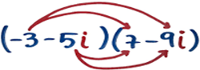
Complex numbers division:
$\frac{a + bi}{c + di}=\frac{(ac + bd)+(bc - ad)i)}{c^2+d^2}$
| Rule | Equivalent | Exponent |
|---|---|---|
| $i^1 = i$ | $i^{4n + 1} = i$ | Multiple of 4 + 1 ${4n + 1, \ n \in \mathbb{Z}} = {1; 5; 9...}$ |
| $i^2 = -1$ | $i^{4n + 2} = -1$ | Multiple of 4 + 2 ${4n + 2, \ n \in \mathbb{Z}} = {2; 6; 10...}$ |
| $i^3 = -i$ | $i^{4n + 3} = -i$ | Multiple of 4 + 3 ${4n + 3, \ n \in \mathbb{Z}} = {3; 7; 11...}$ |
| $i^4 = 1$ | $i^{4n} = 1$ | Multiple of 4 ${4n, \ n \in \mathbb{Z}} = {4; 8; 12...}$ |
Polar form

The polar form of a complex number is:
z = r(cos(θ) + isin(θ)) = reiθ
Here, |z|(or r) is known as the complex modulus
θ is known as complex argument or phase.
Тhe dashed circle above represents the complex
modulus |z| of z and the angle θ represents its complex
argument.
Let we have two complex numbers z1 and z2 in polar form:
z1 = r1(cos(θ1) + i⋅sin(θ1))
z2 = r2(cos(θ2) + i⋅sin(θ2))
then
z1⋅z2 = r1⋅r2[cos(θ1 + θ2) + i⋅sin(θ1 + θ2)]
$\frac{z_1}{z_2}=\frac{r_1}{r_2}[\cos(\theta_1-\theta_2)+i\cdot \sin(\theta_1-\theta_2)]$
Moivre's formulas
The powers of a complex number:
zn = rn(cos(nθ) + i⋅sin(nθ))
Finding the nth root of a complex number:
$\sqrt[n]{z}=\sqrt[n]{r}(\cos(\frac{\theta+2k\pi}{n})+i\cdot \sin(\frac{\theta+2k\pi}{n}))$
k = 0, 1, 2,..., n-1
