
 MENU
MENU
3693693639363936393639363939393939393939393939393939393639393939393939393939393939393639393639393939639396992
There you go nerds I found a number that surpasses the four two one trap I'm not sure how far it goes because I found it using the calculator on my phone well over an hour and it seems to be continuing to rise well past the quadrillion mark and has a creeping gain of numbers in small sections. It looks like it could continue on this path to infinity so if you have a program to run the collatz conjecture try this input. Sincerely Anthony Ryan xvaver
No registration required!
I have the proof to Collatz conjecture.
26 posts
• Page 2 of 2 • 1, 2
Re: I have the proof to Collatz conjecture.
 by Guest » Fri May 27, 2022 10:07 am
reached 1 after 2744 steps, this is quite fast for such a big number.
btw, if there is a counterexample, then it needs at least "17 087 915" steps (see https://en.wikipedia.org/wiki/Collatz_conjecture)
btw, if there is a counterexample, then it needs at least "17 087 915" steps (see https://en.wikipedia.org/wiki/Collatz_conjecture)
- Guest
Re: I have the proof to Collatz conjecture.
by Guest » Thu Nov 10, 2022 12:48 pm
In Collatz Conjecture
If x = ⅓ please check
It prove's it as 0
If x = ⅓ please check
It prove's it as 0
- Guest
Re: I have the proof to Collatz conjecture.
by Nobody Knows » Wed Nov 16, 2022 12:11 pm
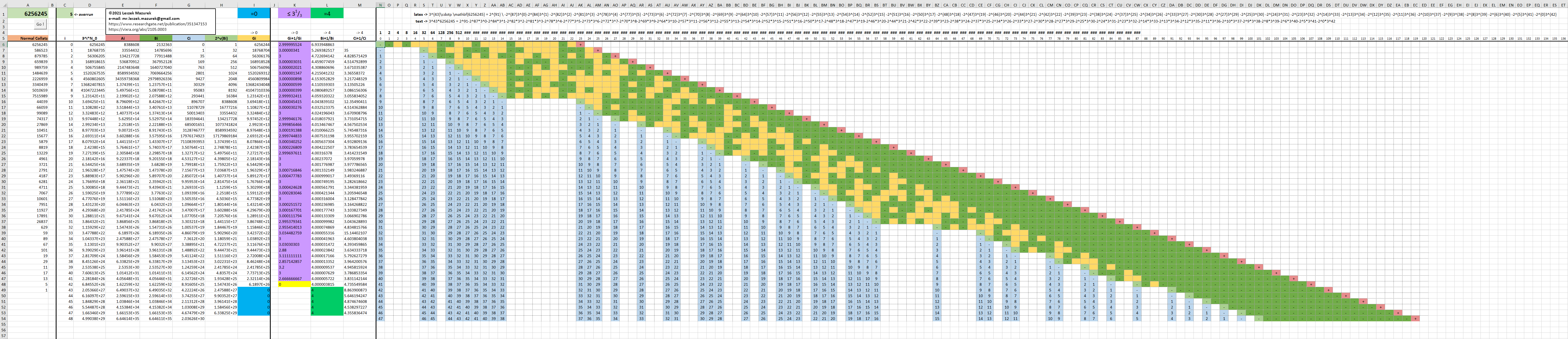
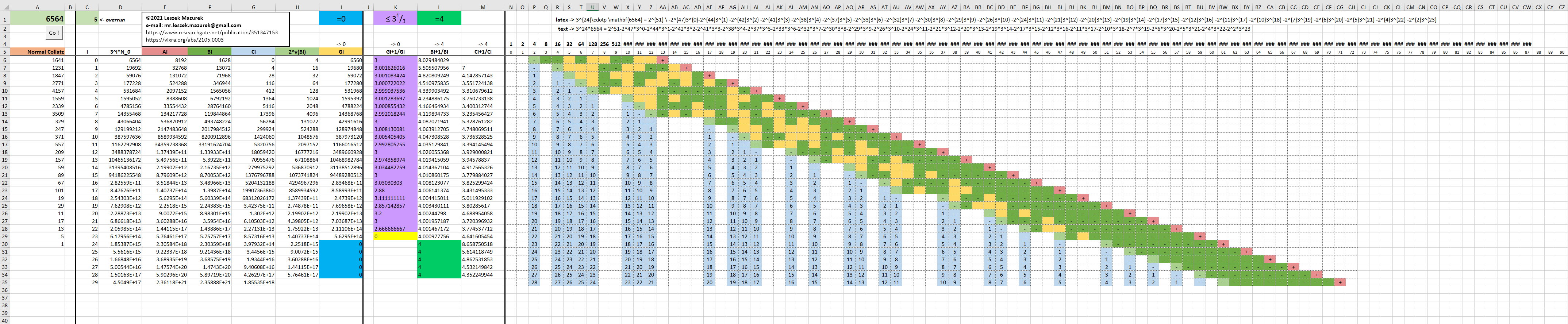
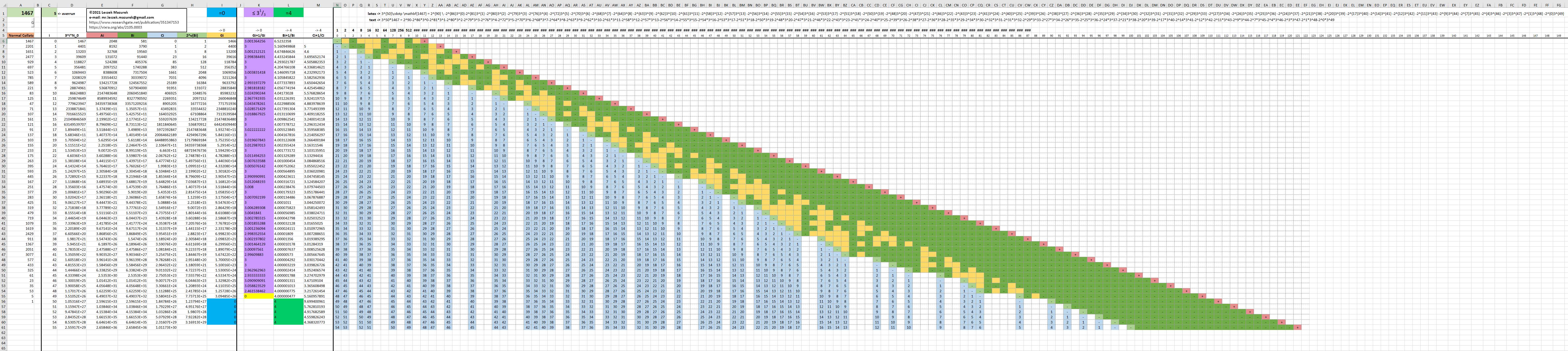
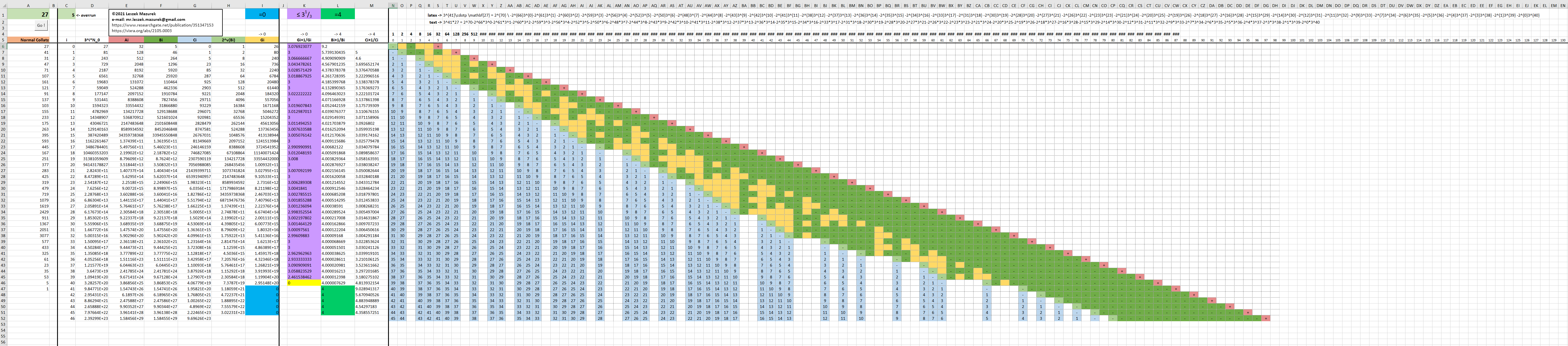
Guest wrote:Full proof -> https://www.researchgate.net/publication/351347153_COLLATZ_CONJECTURE_-THE_PROOF
- Nobody Knows
- Posts: 35
- Joined: Mon Nov 14, 2022 1:09 pm
- Reputation: 2
Re: I have the proof to Collatz conjecture.
by Guest » Tue Feb 07, 2023 2:47 am
Hi,
According to your definition of xn, it is always more than x0. Why are any further steps needed?
According to your definition of xn, it is always more than x0. Why are any further steps needed?
Guest wrote:Let $x_n$ be an odd positive integer. From the sequence’s formula, $x_{n+1}=\frac{3x_n+1}{2^k}$, $x_{n+2}=\frac{3x_{n+1}+1}{2^m}$ and so forth, $m,k\in \mathbb{Z^+}$
For there to exist a cycle in the sequence, there must exist an odd integer $x_0$ such that $x_n=x_0$.
Let $x_1$, the next odd integer after $x_0$,be given by
$$x_1=\frac{3x_0+1}{2^{a_1}}$$
$x_2$ will be given by
$$x_2=\frac{3x_1+1}{2^{a_2}}$$
$x_2$ in terms of $x_0$ will be
$x_2=\frac{3(\frac{3x_0+1}{2^{a_1}})+1}{2^{a_2}}=\frac{9x_0+3+2^{a_1}}{2^{a_1+a_2}}$
$x_3$ will be given by
$x_3=\frac{3x_2+1}{2^{a_3}}=\frac{3(\frac{3x_1+1}{2^{a_2}})+1}{2^{a_3}}=\frac{3(\frac{9x_0+3+2^{a_1}}{2^{a_1+a_2}})+1}{2^{a_3}}=\frac{27x_0+9+3.2^{a_1}+2^{a_1+a_2}}{2^{a_1+a_2+a_3}}$
From the three examples, we can generate a formula for $x_n$ in terms of $x_0$,which will be
$$x_n=\frac{3^nx_0+3^{n-1}+3^{n-2}2^{a_1}+3^{n-3}2^{a_1+a_2}+\cdots +3.2^{\sum\limits_{n=1}^{n-2}a_i}+2^{\sum\limits_{n=1}^{n-1}a_i}}{2^{\sum\limits_{n=1}^na_i}}$$
Let $x_n=x_0$, hence
$$x_0=\frac{3^nx_0+3^{n-1}+3^{n-2}2^{a_1}+3^{n-3}2^{a_1+a_2}+\cdots +3.2^{\sum\limits_{n=1}^{n-2}a_i}+2^{\sum\limits_{n=1}^{n-1}a_i}}{2^{\sum\limits_{n=1}^na_i}}$$
Let $\sum\limits_{n=1}^na_i$ be $k$
$$2^kx_0-3^nx_0=3^{n-1}+3^{n-2}2^{a_1}+3^{n-3}2^{a_1+a_2}+\cdots +3.2^{\sum\limits_{n=1}^{n-2}a_i}+2^{\sum\limits_{n=1}^{n-1}a_i}$$
$$x_0(2^k-3^n)=3^{n-1}+3^{n-2}2^{a_1}+3^{n-3}2^{a_1+a_2}+\cdots +3.2^{\sum\limits_{n=1}^{n-2}a_i}+2^{\sum\limits_{n=1}^{n-1}a_i}$$
$2^k$ can be expressed as $(2^{\frac{k}{n}})^n$
$$x_0[(2^{\frac{k}{n}})^n-3^n]=3^{n-1}+3^{n-2}2^{a_1}+3^{n-3}2^{a_1+a_2}+\cdots +3.2^{\sum\limits_{n=1}^{n-2}a_i}+2^{\sum\limits_{n=1}^{n-1}a_i}\tag{1}$$
When factoring,
$$a^n-b^n=(a-b)(a^{n-1}+a^{n-2}b+a^{n-3}b^2+\cdots +a.b^{n-2}+b^{n-1})$$
This is same as
$$a^n-b^n=(a-b)(b^{n-1}+b^{n-2}a+b^{n-3}a^2+\cdots +b.a^{n-2}+a^{n-1})$$
We therefore notice the polynomial in equation (1) is regular.
Hence, $x_0[(2^{\frac{k}{n}})^n-3^n]$ can be expressed as,
$$x_0[(2^{\frac{k}{n}})^n-3^n]=x_0(2^{\frac{k}{n}}-3)(3^{n-1}+3^{n-2}2^{\frac{k}{n}}+3^{n-3}(2^{\frac{k}{n}})^2+\cdots +3(2^{\frac{k}{n}})^{n-2}+(2^{\frac{k}{n}})^{n-1})$$
$$=3^{n-1}(2^{\frac{k}{n}}-3)x_0+3^{n-2}2^{\frac{k}{n}}(2^{\frac{k}{n}}-3)x_0+3^{n-3}(2^{\frac{k}{n}})^2(2^{\frac{k}{n}}-3)x_0+\cdots +3(2^{\frac{k}{n}})^{n-2}(2^{\frac{k}{n}}-3)x_0+(2^{\frac{k}{n}})^{n-1})(2^{\frac{k}{n}}-3)x_0$$
Each term in this polynomial corresponds to the terms in the polynomial in equation (1).
$\begin{align*}
3^{n-1}\quad &:\quad 3^{n-1}(2^{\frac{k}{n}}-3)x_0\\
3^{n-2}2^{a_1}\quad &:\quad 3^{n-2}2^{\frac{k}{n}}(2^{\frac{k}{n}}-3)x_0\\
3^{n-3}2^{a_1+a_2}\quad &:\quad 3^{n-3}(2^{\frac{k}{n}})^2(2^{\frac{k}{n}}-3)x_0\\
\vdots\qquad &:\qquad \vdots \\
3.2^{\sum\limits_{n=1}^{n-2}a_i}\quad &:\quad 3(2^{\frac{k}{n}})^{n-2}(2^{\frac{k}{n}}-3)x_0\\
2^{\sum\limits_{n=1}^{n-1}a_i}\quad &:\quad (2^{\frac{k}{n}})^{n-1})(2^{\frac{k}{n}}-3)x_0
\end{align*}$
Hence, each of these corresponding terms will be equal. Hence,
$3^{n-1}=3^{n-1}(2^{\frac{k}{n}}-3)x_0\\ 1=(2^{\frac{k}{n}}-3)x_0\\ x_0=\frac{1}{(2^{\frac{k}{n}}-3)} $
Substituting this in the next pair of terms,
$3^{n-2}2^{a_1}=3^{n-2}2^{\frac{k}{n}}(2^{\frac{k}{n}}-3)\frac{1}{(2^{\frac{k}{n}}-3)}\\2^{a_1}(2^{\frac{k}{n}}-3)=2^{\frac{k}{n}}(2^{\frac{k}{n}}-3)\\2^{a_1}=2^{\frac{k}{n}}$
Substituting this in equation (2),
$$x_0=\frac{1}{(2^{a_1}-3)}$$
The only value that satisfies this equation such that $x_0$ and $a_1$ are both positive integers is $a_1=2$ to give $x_0=1$.
- Guest
26 posts
• Page 2 of 2 • 1, 2
Who is online
Users browsing this forum: No registered users and 37 guests