
 MENU
MENU
No registration required!
A complete proof of the Collatz conjecture
31 posts
• Page 2 of 2 • 1, 2
Re: A complete proof of the Collatz conjecture
 by Guest » Mon Apr 11, 2022 3:42 pm
I see that I can't make myself clearer or make any progress in this way. Here I try another approach to explain and I hope it will be more understandable
- Attachments
-
 reply (13).docx
- (18.37 KiB) Downloaded 254 times
- Guest
Re: A complete proof of the Collatz conjecture
by dodomaze » Mon Apr 11, 2022 4:27 pm
Well, it's good that you cleaned up the notation and made it easier to follow, but claim A2.1 is still unfinished. The sequence generated by [tex]a_0', a_1', ..., a_{nm}'[/tex] begins to take shape and starts with the same [tex]nd_1, nd_2, ...[/tex] as the original; but, again, there is no mention of how the new sequence ends with the same [tex]nd_{nm}[/tex] as the original. Is [tex]a_{nm}' < a_0'[/tex] already? If so, why? Because if it is not, the sequence has not finished yet. For claim A2.1 to be complete, you must prove that [tex]a_{nm}' < a_0'[/tex] after exactly [tex]nd_{nm}[/tex] divisions by 2 from the last multiplication step. (At the moment I would not know how to do that.)
Re: A complete proof of the Collatz conjecture
by Guest » Mon Apr 11, 2022 5:05 pm
Why bother with a so-called proof...?
Play the lottery instead.
Good luck!
Play the lottery instead.
Good luck!
- Guest
Re: A complete proof of the Collatz conjecture
by Guest » Tue Apr 12, 2022 6:44 am
Claim A2.1 is not that [tex]a'_{nm }<a'_{0}[/tex]. It says that if for the initial value [tex]a_{0}[/tex] there is a sequence [tex]nd_{1}...nd_{nm}[/tex] and the series [tex]a_{0}...a_{nm}[/tex], where [tex]a_{0}...a_{nm-1}[/tex] are odd and [tex]a_{nm}[/tex] is an integer, than for the initial value [tex]a'_{0}=a_{0}+k \cdot 2^{nd}[/tex] there is the same sequence and the series [tex]a'_{0}...a'_{nm}[/tex], where [tex]a'_{0}...a'_{nm-1}[/tex] are odd and [tex]a'_{nm}[/tex] is an integer.
The proof that [tex]a'_{nm }<a'_{0}[/tex] appears in the next claim - claim A3.
The proof that [tex]a'_{nm }<a'_{0}[/tex] appears in the next claim - claim A3.
- Guest
Re: A complete proof of the Collatz conjecture
by Guest » Tue Apr 12, 2022 9:17 am
OK, let me try an example:
If the initial value is 135, the generated sequence can be (1,1,2,3) and the series will be (135,203,305,229,86). It can also be (1,1,2,4) and the series will be (135,203,305,229,43) - all terms must be odd except the last one, which can be any integer. In the first case, nd=7. Since [tex]2^{7 }=128[/tex], the initial value 135+128=263 also generates a sequence (1,1,2,3) and the series will be (263,395,593,445,167).
In the second case, nd=8. Since [tex]2^{8 }=256[/tex], the initial value 135+256=391 also generates a sequence (1,1,2,4) and the series will be (391,587,881,661,124) - all odd, last any integer. That's what claim A2.1 says.
If the initial value is 135, the generated sequence can be (1,1,2,3) and the series will be (135,203,305,229,86). It can also be (1,1,2,4) and the series will be (135,203,305,229,43) - all terms must be odd except the last one, which can be any integer. In the first case, nd=7. Since [tex]2^{7 }=128[/tex], the initial value 135+128=263 also generates a sequence (1,1,2,3) and the series will be (263,395,593,445,167).
In the second case, nd=8. Since [tex]2^{8 }=256[/tex], the initial value 135+256=391 also generates a sequence (1,1,2,4) and the series will be (391,587,881,661,124) - all odd, last any integer. That's what claim A2.1 says.
- Guest
Re: A complete proof of the Collatz conjecture
by dodomaze » Tue Apr 12, 2022 1:36 pm
Right, but notice that the reason the numbers 135,203,305,229,86 generated the sequence 1,1,2,3, ending in 3 division steps, is because 86 < 135 - that was your stopping criterion. This is part of the definition of your sequences. And I don't see any reason in claim A2.1 to support your statement that the sequence generated by the starting value 135+128=263 also terminates with 3 division steps. (Please don't detail the steps for the particular case of 263 - claim A2.1 is not about 263 only, is a general claim about an arbitrary sequence constructed from another. The one starting with 263 is only an example; you don't prove this for the general case.)
Suggestion: you docx does not really include the exact definition of a "sequence". Write such a definition, in the form of a list of items that an entity must comply with (like a checklist) in order to be called "a sequence". ("It this a sequence? check... check... check... ok, it fulfills all conditions, so it is a sequence.") Then use this checklist to verify if the object you produce at the end of A2.1 can indeed be called a sequence.
I have to recur to this excruciating level of detail, because you assume something, then forget your assumptions.
Suggestion: you docx does not really include the exact definition of a "sequence". Write such a definition, in the form of a list of items that an entity must comply with (like a checklist) in order to be called "a sequence". ("It this a sequence? check... check... check... ok, it fulfills all conditions, so it is a sequence.") Then use this checklist to verify if the object you produce at the end of A2.1 can indeed be called a sequence.
I have to recur to this excruciating level of detail, because you assume something, then forget your assumptions.
Re: A complete proof of the Collatz conjecture
by Guest » Sat Apr 16, 2022 6:24 pm
Guest wrote:Why bother with a so-called proof...?
Play the lottery instead.
Good luck!
Cmon, dynamic duo (Batman & Robin), the truth of ABC conjecture
proves the Beale conjecture, and the Collatz conjecture is also true. Study/review the works on this site.
What's the point of your work?
And why reinvent the "wheels" over again?
Play your hunch (lottery pick) and win a bunch ($$$) if you're so lucky.
Good luck!
- Guest
Re: A complete proof of the Collatz conjecture
by Guest » Sat Apr 16, 2022 6:40 pm
I think some of lotteries in the US are rigged.
And the game life is not fair (rigged too). Go figure!
And the game life is not fair (rigged too). Go figure!
- Guest
Re: A complete proof of the Collatz conjecture
by Guest » Wed Apr 20, 2022 1:31 am
Here I try to define the terms more accurately. Please tell me if now it's correct. TNX
- Attachments
-
- reply.docx
- (19.73 KiB) Downloaded 264 times
- Guest
Re: A complete proof of the Collatz conjecture
by Nobody Knows » Wed Nov 16, 2022 12:26 pm
full proof -> https://www.researchgate.net/publication/351347153_COLLATZ_CONJECTURE_-THE_PROOF
Images that can help to process and understand this proof (they are NOT part of the proof)
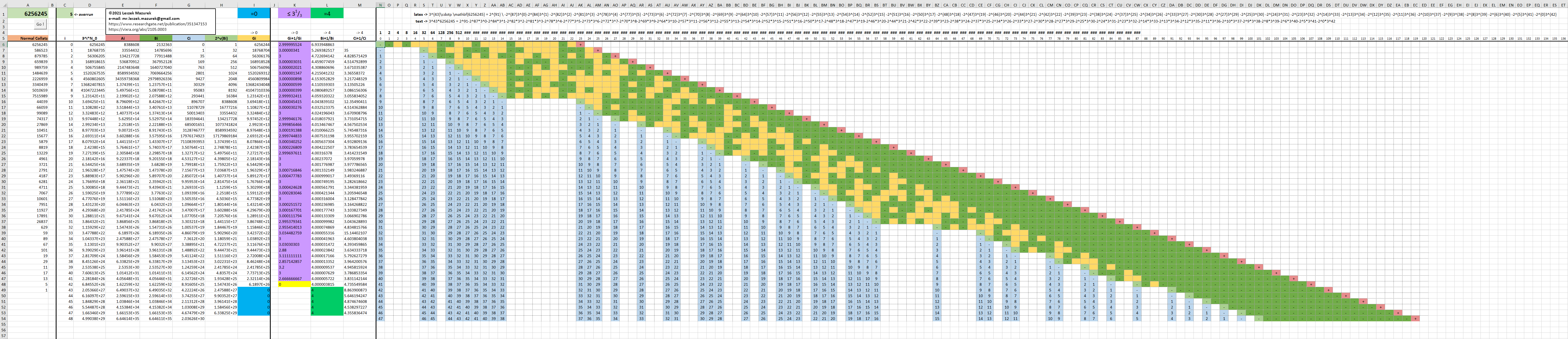
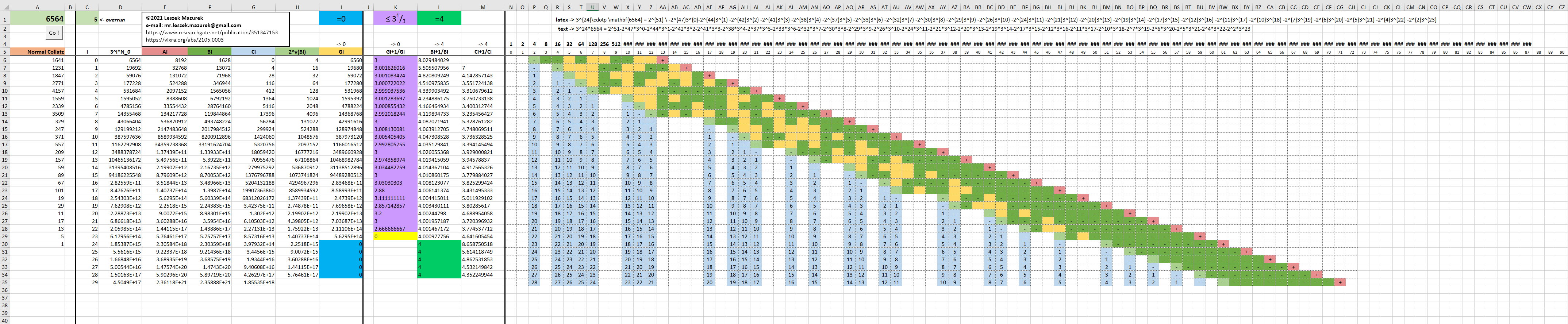
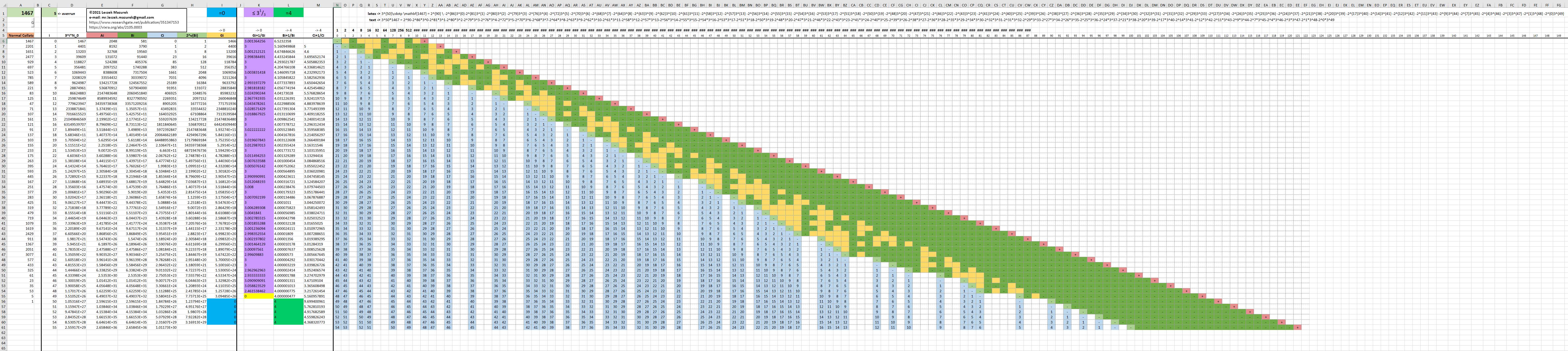
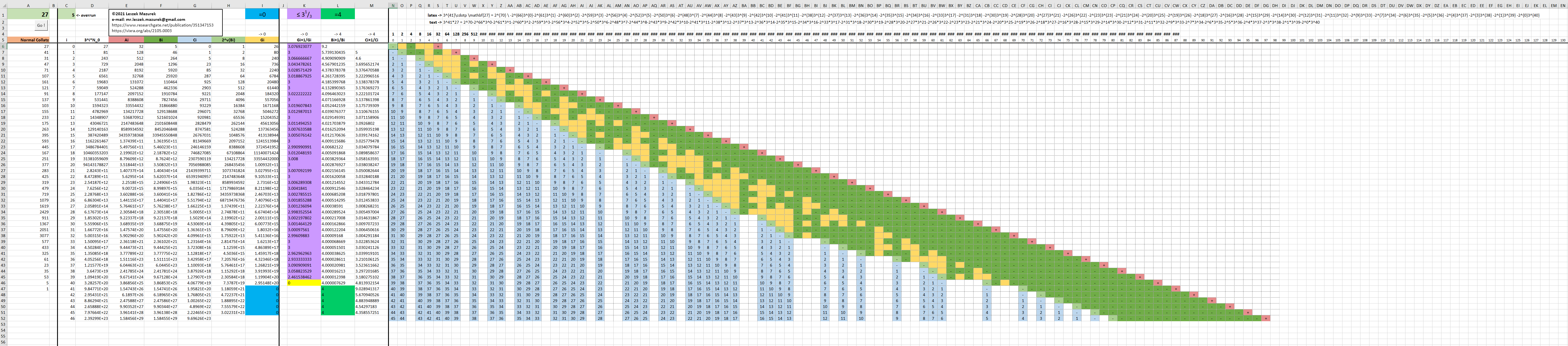
Images that can help to process and understand this proof (they are NOT part of the proof)
- Nobody Knows
- Posts: 35
- Joined: Mon Nov 14, 2022 1:09 pm
- Reputation: 2
31 posts
• Page 2 of 2 • 1, 2
Who is online
Users browsing this forum: No registered users and 40 guests